
Casinos That Accept E-Checks in the UK: Payment Guide
 Available in GB
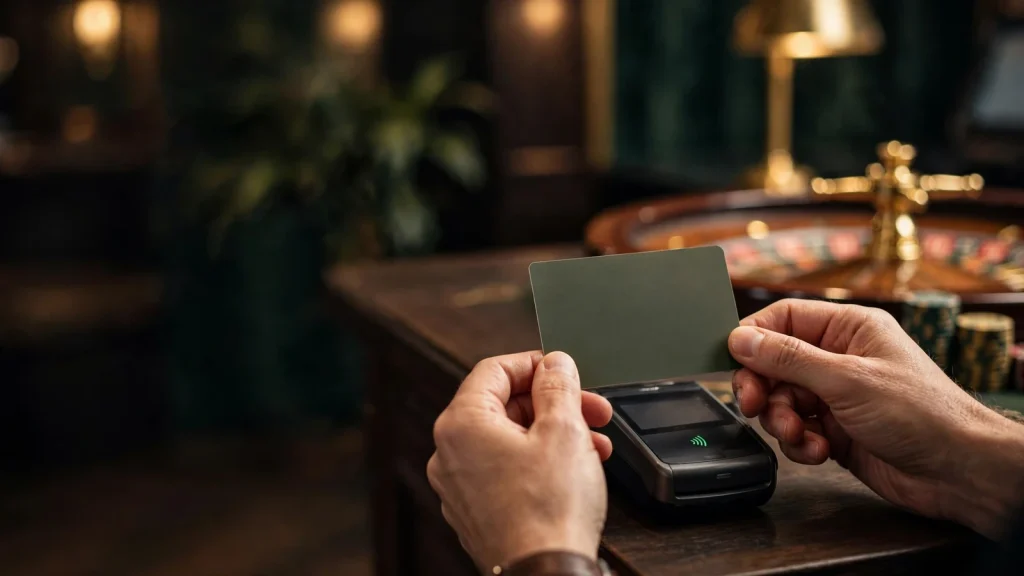
The e-check label can refer to different bank-based routes, so availability depends on the casino, account, currency and transaction type.
What “E-check” Means for UK Casino Payments
“E-check” is not a single, standard UK casino payment brand. The term generally describes an electronic version of a bank cheque: funds are authorised from a bank account and processed through an electronic payment system rather than through a paper cheque. In casino copy, however, the label can be used loosely. It may refer to a direct bank-account debit, an online banking route, or a payment service that handles the bank connection behind the scenes.
That distinction matters. A casino page can mention bank payments without offering a product specifically called an e-check. Equally, a payment provider may describe its service in technical terms that never use the word “e-check”. The same basic movement of money can therefore appear under different headings in a cashier.
I have seen this cause confusion from the operator side. A payment method is often presented as a logo or a short label, while the actual route is determined only after the account, currency, country and transaction type have been checked. “Bank payment” is a category. It is not proof that every bank-based method is available.
E-check, bank transfer and open banking are not interchangeable
A bank transfer normally involves sending money from a bank account to the casino’s nominated account or payment partner. An open-banking route connects the payment flow to the bank and can request authorisation within the banking session. An e-check, in the narrower sense, is an electronic bank-account payment processed through a cheque-like clearing arrangement.
These routes can overlap in everyday casino wording, but their operating details may differ:
- the account used to fund the transaction;
- the authorisation step;
- the payment provider processing the request;
- whether the route is intended for deposits, withdrawals or both;
- the currencies and banks supported;
- the way the transaction appears in the casino account history.
That is why “casinos that accept e-check” should not be read as a reliable list of a universally recognised payment method. It describes a desired route, not a guarantee that the cashier will use that exact name.
What the term does not establish
The phrase alone does not establish that a UK customer can deposit through an e-check. It does not establish that withdrawals can be sent back through the same route either. Payment availability is account-specific and can change with the operator, the payment processor, the customer’s location, the selected currency and the type of bank product being used.
A general payment page may mention cards, bank payments or electronic wallets while the live cashier presents a narrower selection. UK-licensed casinos cannot accept credit-card payments for gambling, so a card logo must not be treated as permission to use a credit card.
The wording “e-check deposit” also says nothing about the source of funds. A payment route may draw money from a bank account, but the casino can still require the gambling account and payment account to correspond. A bank-based label does not remove ownership checks or other transaction controls.
Currency is part of the method
Currency is another detail hidden by the label. A payment route may be technically available while the account is configured in a different currency. Otherwise, a bank or payment provider may perform a conversion even though the underlying payment method appears suitable for a UK account.
Casinos That Accept Tether in the UK: Payment Guide · Casinos That Accept Click2Pay in the UK · Casinos That Accept MuchBetter in the UK
This is not merely a display issue. The amount shown at the casino, the amount authorised by the bank and the amount finally settled can be affected by currency handling. A method that looks like a straightforward bank payment can therefore have different practical terms when the account currency and bank currency do not match.
How to interpret “e-check casinos” in Britain
The sensible interpretation is “UK-facing casino sites where an electronic bank-account payment route might be available”, rather than “casinos with a guaranteed button labelled E-check”. That wording keeps the commercial label separate from the payment mechanics.
It also avoids treating overseas terminology as a statement about British availability. Remote gambling operators selling into Great Britain must hold the relevant Gambling Commission licence, and legal online casino gambling in the UK is provided through licensed and regulated sites. The payment description does not replace that status, and an e-check label does not turn an otherwise unsuitable site into a UK casino option.
The phrase “best casinos that accept e-check” is particularly unreliable as a description of a payment method. “Best” can refer to banking terms, game selection, bonuses or editorial preference, while “accept e-check” may refer only to a broad bank-payment category. Those are separate claims and should not be merged.
Payment Method Type Electronic version of a bank cheque
UK Availability Subject to Gambling Commission licensing
Verification Requirement Ownership matching and KYC necessary
The useful question is narrower: what payment route is actually offered to the account, who processes it, which currency is supported, and whether the route is available for the required transaction type? Once the label is stripped away, the mechanics become clearer.
Labels hide mechanics.
How to Check Whether a Casino Cashier Supports the Payment Route
A payment method mentioned on a casino’s general information page is not automatically available to every account. The useful test is inside the cashier, after registration and login. That is where a remote gambling licensee can show the methods enabled for the account, the account currency, and the transaction direction supported by each route.
This distinction matters for searches about e-check online casino sites in the UK. “E-check” can describe more than one banking route, and a page using the term may be discussing a service in general rather than confirming that the casino can process it for British customers. The cashier is closer to the actual transaction. Still, its display has to be read carefully.
Start with the account cashier
The first check is simple: open the deposit area and inspect the payment tiles or menu. A method should be treated as available only when it can actually be selected for the account, not merely when its logo appears elsewhere on the site.
The cashier may be different from the public payments page for several reasons:
- eligibility can depend on country and account currency;
- a method may be enabled for deposits but not withdrawals;
- the available route can change after login or account verification;
- the operator may present different options on the website and in its mobile interface;
- a payment brand may be listed under a different name from the service used behind the scenes.
I have seen payment pages describe a broad category while the cashier offered only selected routes within it. That is not necessarily a contradiction. A general page explains the operator’s payment range; the cashier shows what the account can use.
Read the payment label precisely
An e-check route should not be inferred from a bank-transfer icon, a debit-card logo, or a generic “banking” heading. Those labels can refer to separate processing channels with different eligibility rules. The name shown at the point of payment matters.
The same caution applies to searches for casinos that let customers pay by e-check. A bank account being accepted somewhere in the funding chain does not establish that the casino supports an e-check transaction directly. The route may involve an intermediary, a bank connection, or another payment service. Each is a separate option from the operator’s perspective.
The cashier should therefore be checked for:
- the exact payment-method name;
- whether the method is available to the account’s country;
- whether GBP is supported as the account currency;
- whether the route is shown under deposits, withdrawals, or both;
- any instruction about matching the payment account to the casino account.
A payment tile that opens a deposit form answers only the deposit question. It does not establish withdrawal compatibility.
Check both transaction directions
For an e-check casino in the UK, the important distinction is not simply whether money can be sent into the account. The route must also be checked in the withdrawal area if the intention is to use it for the full payment cycle.
Some methods are deposit-only. A prepaid voucher, for instance, is designed to fund an account rather than receive a payout. Other routes may accept a deposit but direct an approved withdrawal to another eligible method. That is why a method should not be described as a complete casino payment option until both directions have been examined.
The practical sequence is:
- open the cashier’s deposit section and identify the available route;
- note the exact name and any account or currency conditions;
- open the withdrawal section separately;
- check whether the same route appears there;
- read the displayed instructions before starting the transaction.
A withdrawal icon can also be conditional. It may become visible only after a deposit, after account checks, or after the operator has confirmed that the payment account belongs to the same customer. The display is evidence of a route being offered, not a promise that every transaction will pass without review.
Match the account details
Payment compatibility is not only a technical matter. The casino account and the payment route should belong to the same customer. Matching names and account information reduce the chance that basic ownership checks create avoidable friction around a transaction.
This is especially important when a banking service or e-check provider uses separate profile details. A casino account registered in one person’s name and a payment account held by somebody else can create an ownership issue even when the route itself is displayed in the cashier. The fact that a transaction can be initiated does not remove that requirement.
DO
- Check the live cashier for specific availability
- Confirm the method supports both deposits and withdrawals
- Ensure the payment account name matches the casino account
DON’T
- Assume a logo on a public page means instant availability
- Treat credit card logos as permission to use credit cards
- Rely on permanent rankings or “best” labels
The cleanest arrangement is often one named account used consistently for both depositing and withdrawing. It gives the operator a clearer record of where the funds came from and where an eligible return should go. Shared accounts, third-party funding, and mismatched personal details make the payment trail harder to interpret.
Treat “available” as account-specific
A payment method can exist on the operator’s site without being available to every customer. The reliable wording is therefore account-specific: the route is displayed in the logged-in cashier, in the relevant transaction section, and with instructions that fit the account.
That is the standard I would use before describing a site as able to pay by e-check. Not a logo. Not a promotional paragraph. The cashier, checked in both directions.
The same approach applies when comparing the supposed best or top e-check online casinos in the UK. A ranking cannot establish compatibility for a particular account. The decisive check remains the operator’s own cashier, followed by confirmation that the route supports the intended transaction direction and uses payment details belonging to the same customer.
Payment Summary
- Payment availability is account-specific and must be verified in the cashier
- The term “e-check” can refer to various electronic banking routes
- Withdrawal speed and direction depend on both casino approval and bank processing
- Matching account details is essential for successful ownership verification
Top online casinos in the UK
- Revery PlayBonus: 100% up to€1,000+ 100 FS · Payout speed: 1-3 business days
- ChanzeBonus: Slots Welcome Bonus #1 200% up to €500 · Payout speed: 1-3 business days
- SlotoSportBonus: 500% up to £ 10 200+ 777 FS · Payout speed: 1-3 business days
- AmunbetBonus: Join now and get 450% up to 2,700 GBP + 450 FS · Payout speed: 1-3 business days
- NightLuckBonus: Welcome Pack + 805% Up To 6400€ + 280 FS · Payout speed: 1-3 business days
- BritsinoBonus: Welcome Package – Get your £2,200 + 2,000 FS · Payout speed: 1-3 business days
Casino Sites and the Payment Options They Actually Show
A casino payment page can look broader than the payment choice available inside a particular account. A public page may display familiar card brands, bank transfers, electronic wallets and even several cryptocurrencies, while the cashier presents a narrower selection after location, currency, account status or other eligibility checks have been applied.
That distinction matters when assessing sites associated with e-check deposits in the UK. A payment logo is evidence of what a site says it supports in some context. It is not, by itself, confirmation that a UK customer can use that route, fund an account with it, or receive a withdrawal through it.
What a displayed method actually tells you
Payment information tends to appear in several places:
- a general payments page;
- a registration or help page;
- the cashier after login;
- deposit instructions;
- withdrawal instructions;
- promotional terms.
These locations do not carry the same weight. A general page may describe the operator’s wider payment catalogue. The cashier is closer to the account-specific position, because it can reflect the selected country, account currency and available transaction functions.
The wording also needs reading carefully. “Accepted payment methods” may refer only to deposits. “Fast payments” may describe processing at the provider rather than the casino’s internal handling. A brand shown among payment icons may be available for one transaction direction but not the other. None of those phrases establishes that an e-check route is usable for both funding and cashing out.
I have seen payment pages treated as product lists when they were really broad marketing summaries. That is where the “top” or “best” label becomes unhelpful: it can make a displayed logo sound like a confirmed recommendation.
Separating categories from confirmed availability
Visa and Mastercard appear as card options; bank transfer is presented separately; e-wallets form another group; and some pages refer to multiple cryptocurrencies.
The same caution applies to Visa and Mastercard. Card availability and card-product eligibility need to be checked in the live payment area. A displayed brand is not a substitute for that check.
Casinos That Accept Boku in the UK: Deposits Explained · Casinos That Accept iDEAL in the UK: What to Check
This is especially important in the UK, where credit-card payments for gambling are not permitted at licensed casinos. A reference to a card brand therefore cannot be read as approval for every card carrying that brand. The relevant question is what type of card and funding route the cashier accepts for the account, not simply which logo appears on a webpage.
Why an e-check label needs extra care
“E-check” is not a universal cashier category. One operator may use a named payment provider, another may describe a bank-based route, and a third may show only a general bank-transfer heading. The label used on an information page may therefore fail to match the wording used at the transaction stage.
For that reason, a site should not be placed on a list of e-check casino sites merely because its payment page includes bank transfers, wallets or card brands. Those categories may be relevant to the search, but they do not prove that the intended route is available for deposits in the UK. They also do not prove that the same route supports withdrawals.
UK-licensed casinos are strictly prohibited from accepting credit-card payments for gambling purposes.
A specialist casino review can help identify which payment categories a site advertises, but it remains a secondary description. The operator’s current cashier is the more useful reference for the account actually being used. Even then, the displayed deposit and withdrawal panels should be read separately.
A practical way to record what a site shows
A simple comparison record prevents broad claims from becoming false certainty:
| Point to record | What it establishes |
|---|---|
| Payment name or category | How the site labels the route |
| Location of the information | Whether it appears on a public page or inside the cashier |
| Deposit availability | Whether the route is offered for adding funds |
| Withdrawal availability | Whether the route is offered for receiving funds |
| Account and currency context | Whether the display applies to the relevant UK account |
| Product restrictions | Whether the payment instrument itself may be ineligible |
This is not a ranking table. It is a way of separating an advertised category from an account-level option. A site can appear in a review of payment methods without qualifying as a confirmed e-check deposit casino for every UK customer.
The cleanest wording is therefore precise: a site displays card, transfer, wallet or cryptocurrency categories, while current UK availability must be confirmed in its cashier. That phrasing preserves what the payment page shows without turning a broad reference into an unsupported recommendation.
Comparing Payment Routes Without Trusting “Best” Claims
“Best” is usually a shortcut for a particular preference: the lowest visible charge, the quickest confirmation, or the simplest route for a specific account. Those are different tests. A payment method described as the best option for an e-check deposit may be less suitable once provider charges, currency conversion or the return route are included.
I have found that payment comparisons become more useful when the word is removed and the transaction is separated into its actual parts. The relevant question is not which method has the strongest label, but what the complete movement of money costs and how long each stage can take.
Compare the full cost, not the displayed fee
A payment route can involve more than a charge shown by the casino. The possible components include:
- a casino deposit or withdrawal fee;
- a fee from the payment provider;
- an issuer or bank charge;
- a currency-conversion spread;
- a network fee.
These costs do not necessarily appear in the same place. A cashier may show one amount, while the payment provider applies another during processing. A bank or card issuer may also calculate its own charge independently. The amount arriving in the gambling account is therefore not always the right figure for judging value; the amount leaving the account, and any amount lost on the way back, matter as well.
A specialist payment review makes the useful point that there is no universal lowest-fee method. That is the right way to read claims about cheap e-check casinos in the UK: a route must be assessed against the actual transaction amount, account currency and provider terms, not placed in a permanent ranking.
A conversion spread deserves particular attention. It is less visible than a flat charge, but it can cost more than that clearly labelled fee. This matters when the payment account and the casino account use different currencies. Even where the cashier presents a familiar amount, the provider’s exchange rate may change the final cost.
The practical comparison is simple:
| Cost point | What to establish |
|---|---|
| Casino | Whether the operator adds a payment charge |
| Provider | Whether the e-check or wallet service applies its own fee |
| Bank or issuer | Whether the underlying account adds a transaction or conversion cost |
| Currency | Whether the payment is processed in GBP or converted |
| Network | Whether a separate network charge is involved |
This is less attractive than a “best method” badge. It is more accurate.
Treat speed as a chain of events
“Instant” can describe only one part of a transaction. A deposit may be confirmed by the cashier quickly while the payment provider, bank or account ledger completes another stage later. For withdrawals, the timing can be affected by internal approval and verification as well as by the delivery route. Those stages should not be collapsed into one promise.
Bank transfers show why a simple speed ranking can mislead. A specialist review identifies cut-off times, weekends and currency conversion as factors that can affect delivery. A transfer submitted after a processing cut-off may therefore behave differently from one submitted earlier, even when the selected route has not changed. Non-working days can also interrupt the hand-off between the casino, bank and recipient account.
The same distinction applies when comparing an e-check route with a card, wallet or bank method. “Instant e-check casino” may describe the deposit confirmation visible on screen, not the whole payment journey. The label says little about whether a withdrawal follows the same path or whether another stage is applied.
For a useful comparison, record four separate points:
- when the cashier accepts the request;
- when the payment provider shows the transaction as processed;
- when any internal account review is complete;
- when the funds are delivered to the receiving account.
That structure prevents a fast deposit from being mistaken for a fast cash-out. It also keeps cost and timing separate: a method may be inexpensive but affected by conversion, or quick at the first stage but slower at delivery.
Ignore permanent rankings
Payment availability and commercial terms can change by operator, account, currency and provider. A page presenting the best e-check casinos for 2026 as a fixed league table is therefore less useful than a comparison based on the live terms attached to the particular account.
The same principle applies to sites mentioning Visa, Mastercard, bank transfer, wallets or cryptocurrency. A payment logo is not a price comparison, and a short processing description is not a complete timing guarantee. The meaningful assessment comes from the charge structure and the route’s separate stages.
I have made the mistake of comparing only the visible cashier fee. The missing cost was in the exchange rate. That is the detail that survives the headline.
Understanding Costs
When comparing methods, look beyond the visible casino fee. Total costs include provider charges, bank/issuer fees, and potential currency conversion spreads.
Real-Money Deposits, Withdrawals and the Return-to-Source Rule
Real-money casino payments have two separate stages: getting funds into the account and getting an approved balance back out. They may use the same payment route, but they do not follow the same timetable. A deposit can be authorised quickly, while a withdrawal remains pending until the casino completes its checks and applies its payment rules.
This distinction matters when assessing an e-check-style payment route. A cashier showing a route for deposits does not, by itself, establish that the same route can receive a payout. The practical question is whether the payment method is available on both sides of the transaction and how the operator handles the balance after play.
A card illustrates the difference clearly. A card deposit may appear immediately in the casino account, whereas the related withdrawal can take several business days. That timing is reported by a specialist review, so it should be treated as a description of the arrangement examined there rather than a fixed term for every UK account. “Instant deposit” describes the crediting stage only.
Why the money may return to its source
UK anti-money-laundering controls commonly require a casino to send funds back through the payment source used for the deposit. This is often called the return-to-source principle. It gives the operator a traceable link between the account, the incoming money and the eventual payout, rather than allowing funds to be redirected freely to an unrelated destination.
Return-to-Source
Attention UK anti-money-laundering controls often require funds to be returned to the original payment source used for the deposit.
In practical terms, a deposit made through one account may lead to a payout being sent back through that same account, subject to the operator’s cashier rules. The route may be described in promotional material as a real-money deposit option, but the withdrawal path still depends on the individual casino’s processing setup.
The control is not limited to cards. It can affect bank-linked services, e-wallets and other payment channels. Where the original route cannot receive the full amount, the casino may use another permitted method or request further evidence before releasing the funds. That alternative is not an automatic entitlement; it is part of the operator’s review.
What this means for cash flow
The balance shown after a deposit is therefore not the same as money immediately available in a personal bank account. A quick deposit can support play at once, but a payout may wait for approval, source matching and the appropriate return route. The first transaction through a new method can be particularly sensitive to these checks.
A sensible comparison separates three questions:
- how quickly the deposit is credited;
- whether the method supports withdrawals as well as deposits;
- where an approved payout will be sent.
The last point is easy to overlook. A payment method can be useful for funding an account but unsuitable as the main cash-out route if it is deposit-only or cannot receive the casino’s payout. Paysafecard, for instance, is a prepaid voucher for deposits only, so it cannot serve as the destination for a withdrawal.
From the operator’s side, the “closed-loop” wording is less about convenience than control. Returning money through the original source helps with fraud prevention and AML checks. A different destination may be possible, but additional verification can be required. That is the operational cost of changing the route.
Deposit Limits and the First Transaction
The first deposit is shaped by the selected payment route, not by a universal casino figure. A specialist review places the lower entry point for many UK casino deposits at £10–£20, with the exact minimum changing according to the method chosen. That range is a reference point rather than a promise attached to every cashier.
This matters when looking for a casino that accepts echeck deposits in the UK. An e-check option, where displayed, may have its own minimum or may not appear for every account. The cashier sets the actionable terms. A payment method listed in general information does not establish that the same route is available for a particular customer or transaction.
First Deposit Checklist
- Identify the minimum deposit amount for your chosen route
- Check if there are maximum limits for the transaction or day
- Confirm the account currency matches the authorized amount
- Verify if the limit changes after account verification
The first transaction also exposes account-level conditions. Maximum deposits can be set per transaction, per day or per month, and those ceilings may differ between payment methods. Account status can affect them as well. A newly opened account may not carry the same permitted amount as an established, fully reviewed account. The distinction is operational, not promotional.
I have seen “high limits” used as a selling point when the meaningful restriction was attached to the payment provider, currency or customer profile. The headline figure was technically accurate; it simply was not the figure available at the cashier. Read the field that governs the transaction.
Before confirming a first deposit, the relevant checks are straightforward:
- identify the minimum shown for the selected route;
- check whether the maximum applies to one transaction, a day or a month;
- confirm the account currency and the amount actually authorised;
- note whether the displayed limit changes after account review.
An amount accepted by the casino does not automatically mean that the payment provider or bank will process it under identical conditions. The cashier’s figures are the practical starting point. Small print matters.
What Can Slow Down a Casino Payment
A withdrawal is not simply a request for money to leave the account. Before release, the remote gambling licensee may need to approve the transaction and complete KYC. Those are separate stages, and either can hold the payment.
A specialist review describes the first withdrawal as a point where verification may take longer. That does not mean every account follows the same path. The internal approval process, the information already held on the account and the status of KYC all affect how quickly a payment moves forward.
Internal approval comes first
The casino checks the withdrawal against its account records and transaction controls. A mismatch between the account details and the payment information can create a manual review. The same applies where the operator needs to confirm that the request fits its procedures before sending it to the payment provider.
This is why the label “instant withdrawal” can be misleading. It may describe the delivery stage after approval, not the time spent waiting for the casino to authorise the payment.
Casinos That Accept Ethereum in the UK: Payment Guide · Casinos That Accept Interac in the UK: What to Know
Why first withdrawals can take longer
The first payout often exposes any unfinished verification work. The operator may need documents or clarification before the withdrawal can proceed. Until KYC is complete, the payment can remain pending even though the balance is available.
A players’ forum also links withdrawal speed with the casino’s approval process and the account’s verification status. That is a useful description of the mechanism, not a fixed timetable.
From the counter side, the practical distinction is simple: a payment can be waiting for a decision inside the casino, rather than travelling through the chosen payment route. An echeck casino payment in the UK therefore depends on more than the cashier displaying a method. Account review comes first.
Pending approval. That is the bottleneck.
Withdrawal Speed: Approval, Verification and Delivery
A withdrawal has two separate stages. The casino must first approve the request; only then does the payment provider or bank deliver the funds. Treating those stages as one countdown is how “instant” wording creates the wrong expectation.
Approval depends on the remote gambling licensee’s internal checks and on whether the account is fully verified. A first withdrawal may therefore take longer while KYC is completed. The payment route cannot remove that casino-side step. In my experience, the useful timestamp is the point at which the cashier marks the withdrawal as approved, not the moment the request was submitted.
Withdrawal Process
First Step: Casino Approval
The operator reviews the request and completes any necessary KYC or internal verification.
Second Step: Payment Delivery
Once approved, the funds move from the casino to the payment provider or bank.
Third Step: Final Receipt
The funds arrive in your account, a stage that can be affected by bank cut-off times or weekends.
The delivery stage begins afterwards. PayPal, open banking services and debit cards connected to fast payout systems are identified in a specialist review as being among the quicker withdrawal routes. That is a description of the route, not a promise for every account: availability, eligibility and the operator’s workflow still determine what happens in a particular cashier.
Bank transfer has more moving parts. Delivery can be influenced by the bank’s cut-off time, weekends and currency conversion. A casino may release the payment promptly, yet the receiving bank’s timetable or a conversion step can extend the overall wait.
This distinction also matters when an e-check route is being considered. A payment method shown for deposits does not automatically establish a withdrawal speed or even payout availability. The relevant evidence is the cashier’s withdrawal screen and the status history of the actual request.
The practical comparison is therefore:
- Casino approval: internal review and any outstanding KYC.
- Payment delivery: movement from the approved request to the payment account.
- Bank route: additional dependence on cut-off times, weekends and currency conversion.
Fast is conditional.
Using a Casino App Without Assuming Every Payment Is Available
A casino app confirms access to the account, not the full set of payment routes. The cashier remains the working record of what that particular account can use. This distinction matters when looking for an e-check route: a payment method described elsewhere may not appear after signing in, and an option shown on the website may not be enabled in the app.
The same applies to cards. Visa and Mastercard may be listed among an operator’s payment methods, but that label does not settle whether a particular UK card product is eligible. The app cashier has to show the available route for the account and the selected transaction. UK-licensed casinos cannot accept credit-card payments for gambling, so a card logo is not permission to use every card carrying that brand.
I have seen payment pages treated as static menus. They are not. The displayed options can depend on account details, jurisdiction, currency, verification status and whether the transaction is a deposit or a withdrawal. An app can therefore be perfectly functional while offering fewer payment choices than a desktop cashier.
Currency is another small detail with a direct financial effect. GBP may be supported, but the account currency still needs checking before the first transaction. A mismatch can introduce conversion costs even when the payment route itself appears familiar. The label “available in the app” means only that the interface can present the method; it does not establish the currency, eligibility or direction of the transaction.
For an e-check casino app in the UK, the sensible sequence is short:
- Open the signed-in cashier rather than relying on an app-store description.
- Check whether the route appears under deposits and whether a withdrawal route is also shown.
- Confirm the account currency and the payment details attached to the account.
- Read the transaction screen before authorising anything.
The app is the doorway. The cashier is the evidence.
Payment Security: Ownership Checks and Account Controls
Payment security at a UK casino starts with a simple ownership question: do the gambling account and the payment route belong to the same customer? Matching the personal details held by the operator with the details attached to an echeck service, bank account, card or wallet reduces the chance of avoidable friction when a transaction is reviewed.
From the operator’s side, this is not just administrative neatness. A payment can require checks against fraud, money laundering and unauthorised use. Differences in names, account details or payment ownership may therefore lead to a request for supporting information or prevent a route from being used as expected. The cleanest arrangement is one named account used consistently for both gambling activity and payments.
That principle matters particularly when an unfamiliar payment route is being considered. An echeck-style service may have its own account holder information, while the casino holds a separate customer profile. If those records do not align, the transaction can become harder to approve even where the cashier displays the method. Availability is not the same as frictionless ownership verification.
Casinos That Accept USDC in the UK: What to Check · Casinos That Accept UKash in the UK: Current Status
I have seen “security” used as a vague reassurance in payment copy. In practice, it is often a set of account controls and matching records.
Financial controls are a separate part of the same protection framework. UKGC rules require a remote gambling licensee to prompt a new customer to set a financial limit before the first deposit. The account must also provide accessible controls for managing those limits afterwards. These settings are not a payment-method feature; they operate at account level and apply to the customer’s gambling funds more broadly.
The important distinction is between a payment being accepted and an account being properly controlled. A cashier may show an available route, but ownership checks and financial-limit prompts still govern how the account can be used. That is the point at which payment convenience meets operator responsibility.
Do UK casino withdrawals require verification?
Yes. First withdrawals may take longer while verification is completed, and withdrawals are generally returned to the original payment source.
Can I deposit in GBP?
Yes, GBP is supported at the listed sites. Check that your account is set to GBP before depositing to avoid currency conversion.
What is the current minimum deposit?
Minimum deposits usually start at £10–£20, depending on the payment method.
Which payment methods are accepted in Great Britain?
Common options include Visa and Mastercard debit cards, PayPal, bank transfers, open banking, Paysafecard, and, at some sites, Skrill, Neteller, Apple Pay or Jeton. The methods available to you are shown in the casino cashier.
Are Visa and Mastercard deposits definitely debit cards?
No. A Visa or Mastercard logo does not confirm that every card product is eligible; check the cashier, and use a debit card. UK casinos cannot accept credit-card payments for gambling.
Which method has the lowest fees?
There is no universally cheapest method. Compare casino and provider charges, bank or issuer fees, currency conversion spreads, and any network costs for the amount you plan to deposit.
Payments
Published by the Casino Not on Gamstop team.