
Is it legal to play at a casino not on GamStop in the UK?
 Available in GB
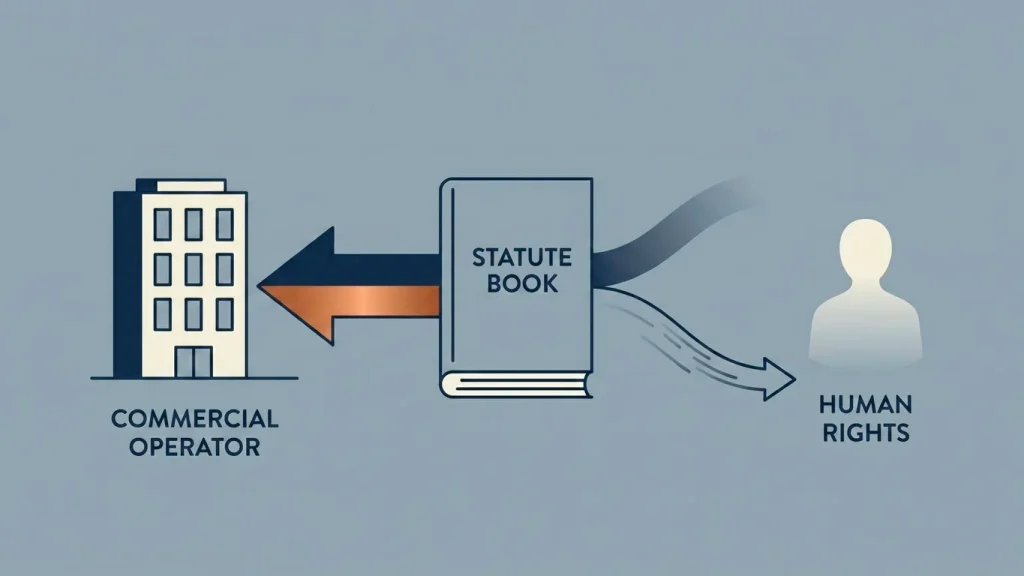
The question of whether it is legal for a UK resident to play at a casino without a UK Gambling Commission licence is one of the most frequently searched topics in the non-GamStop conversation, and one of the most poorly answered. The honest position rests on a clean split: UK statute regulates the supply of gambling, not the consumption of it. The operator side carries the legal exposure; the player side does not. That distinction is set out in the Gambling Act 2005 and reinforced by the Gambling (Licensing and Advertising) Act 2014, and it is the foundation of everything else covered on this page.
Where does a UK player actually stand in law?
The short answer is that no UK player has been prosecuted, fined, or formally penalised by the UK Gambling Commission for using a non-GamStop casino. The reason sits in the wording of the statute. Section 33 of the Gambling Act 2005, the central provision that criminalises unlicensed gambling activity, is directed at any person who “provides facilities for gambling” without the required licence. It is a supply-side offence. The text of the provision is published on legislation.gov.uk and remains the controlling reference, with prosecutions historically running against operators and intermediaries rather than against the consumer end of the chain.
This does not make the position legally weightless. A player who has registered with GamStop and continues to gamble at offshore sites is not acting illegally, but they are bypassing the protective infrastructure that they themselves opted into. That distinction is moral and practical, not criminal. Anyone wanting the technical mechanics of the scheme they would be working around should read our walkthrough of how GamStop itself works, which explains the integration that licensed operators sit inside.
What does the law require of the operator?
For operators, the picture is the inverse. Section 33 makes it an offence to provide facilities for gambling in Great Britain without the relevant operating licence. The penalty on summary conviction can include imprisonment of up to 51 weeks and a fine at level 5 on the standard scale. The Gambling (Licensing and Advertising) Act 2014 then closed the geographic loophole by introducing a point-of-consumption regime: an operator providing remote gambling facilities to consumers in Great Britain needs a UKGC licence regardless of where the operator itself is based. Both pieces of primary legislation are openly published on legislation.gov.uk and remain the operative reference.
Section 36 of the same Act sets out the territorial application, and Section 330 covers the advertising offence. An offshore operator that markets remote gambling to UK residents without a licence is committing the offence even if no UK resident ever deposits, because the supply-side liability attaches to the provision and the marketing rather than to any individual transaction. This is why the UKGC’s enforcement effort is directed at operators, marketing infrastructure, and intermediaries rather than at end users.
How does the UKGC actually enforce this?
UKGC enforcement against unlicensed operators has expanded materially through 2024 and 2025. Public reporting from the Commission describes more than 770 cease-and-desist notices issued since April 2024, divided across operators directly and the advertisers who service them: approximately 262 operator notices and 205 advertiser notices, with the balance covering related parties. The Commission’s takedown work has also scaled in the digital space, with around 200,000 URLs reported to major search engines and roughly 100,000 of those removed by October 2025.
The Commission also publishes an internal tracking list that has exceeded 1,000 illegal operator entities. None of this targets the consumer. Where individual UK residents do face friction, it is almost always at the financial-services layer: card-issuer rejections, bank-transfer blocks, or merchant-coded blocks applied by their high-street institution. Those are commercial decisions taken by the banks under their own risk frameworks, not regulatory penalties.
- Cease-and-desist notices issued since April 2024
- Approximately 770 in total, including roughly 262 operator notices and 205 advertiser notices.
- URLs reported to search engines
- Approximately 200,000, with around 100,000 removed by October 2025.
- Illegal operator entities tracked
- Over 1,000 on the Commission’s internal list.

What about banks blocking payments to offshore sites?
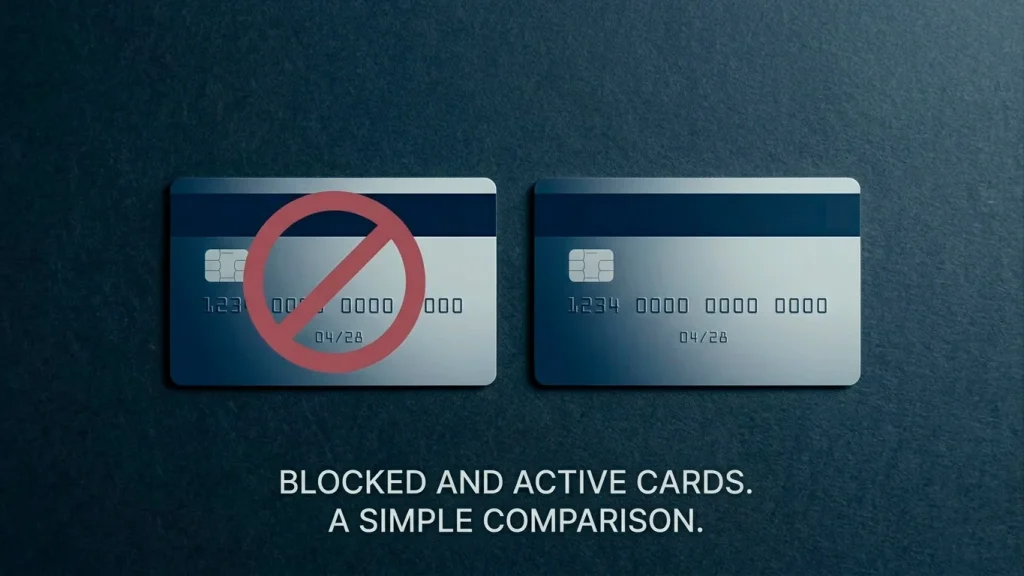
Several major UK banks and fintechs apply restrictions to gambling merchant codes, and some apply additional restrictions where the merchant is not on a curated approved list. Monzo, Revolut, Lloyds, Barclays, HSBC, NatWest and Santander UK each operate variations of this in 2025-26. These restrictions arise under the bank’s own terms of service and risk frameworks. They are commercial decisions, not statutory ones, and they do not create criminal liability for the customer.
The practical implication is that an attempted deposit can be blocked at the issuer level. A blocked transaction is not a fine, a flag against the customer’s record, or any other form of formal sanction. It is a failed payment authorisation. The customer can take it up with the bank under the bank’s own dispute process, but UKGC enforcement is not involved.
Do UK players owe tax on non-GamStop winnings?
Personal gambling winnings are not subject to UK income tax for individual players, and this position is independent of whether the operator is UKGC-licensed or offshore. The general HMRC position, derived from a long line of cases including the principle expressed in McMillan v HMRC (2020) and earlier authorities, is that gambling does not normally amount to a trade or profession for income-tax purposes. The exceptions are narrow and tend to involve professional spread-betting or quasi-trade activity at scale, which falls well outside any consumer scenario.
A separate question can arise where a player funds offshore play with cryptocurrency that was previously acquired as an investment. Disposals of that crypto to fund gambling can trigger capital gains questions under HMRC’s cryptoasset manual, which is published on gov.uk. That is a tax question about the crypto, not about the gambling, and the duty falls on the disposing taxpayer in the same way as any other crypto disposal.

Why is the credit card ban relevant here?
From 14 April 2020 the UK Gambling Commission has prohibited the use of credit cards to fund gambling at UKGC-licensed operators. This ban is a licence condition: it applies to licence holders, not to consumers in general. A non-GamStop operator, by definition, is not a UKGC licence holder and is therefore not bound by it. Many do accept credit cards.
That acceptance is sometimes presented as a feature of the offshore segment, but it is more accurately described as an artefact of the operator’s regulatory position. A consumer using a UK-issued credit card at a non-GamStop site is not breaking the law, but they are also not benefiting from the consumer protection that the UKGC’s credit card ban was designed to deliver. The substance of those trade-offs of stepping outside UKGC is set out in more detail in the dedicated risk-and-protection analysis.
What does the law say about advertising offshore sites to UK consumers?
Section 330 of the Gambling Act 2005 makes it an offence to advertise unlawful gambling, and the framework is supplemented by the Advertising Standards Authority gambling codes (CAP and BCAP). Where an unlicensed operator markets to UK consumers, both the operator and the entity placing the advertising are potentially liable. This is why the UKGC’s recent enforcement push has focused as much on affiliates and ad networks as on operators themselves, and why a substantial fraction of cease-and-desist activity is directed at advertisers.
For a UK resident encountering offshore casino advertising, the legal exposure remains with the publisher and the advertiser, not the reader. The legal question that does arise on the reader’s side is what they then do with the information, and that returns to the central point: consumption is not criminalised in UK gambling statute.
What this means in practice, beyond the headline answer
Legality is the floor, not the ceiling. The absence of criminal liability does not equate to the presence of consumer protection. A non-GamStop operator is by definition outside the LCCP framework, outside UK ADR through the IBAS scheme, outside the financial-vulnerability check regime that took effect on 28 February 2025, and outside the £5 and £2 slot stake limits that took effect on 9 April and 21 May 2025 respectively. The legal “yes” answers a narrow question. The practical position requires the additional reading covered in our Beyond GamStop guide and the dedicated analysis of offshore licensing jurisdictions.
The full picture is in our guide to casinos not on GamStop.
What the scheme itself covers: how GamStop works.
Recommend
Created by the "Casino Not on Gamstop" editorial team.