
How do non-GamStop bonuses and wagering requirements really work?
 Available in GB
A welcome bonus headline at a non-GamStop casino reads larger than a typical UKGC equivalent. The arithmetic underneath is what determines whether that headline translates into recoverable value or simply into more turnover obligation before any withdrawal is possible. This page works through the mechanics in detail, with a worked example, and sets the offshore picture against the UKGC framework as it now stands after 19 January 2026. The wider context for this material is laid out in the Beyond GamStop UK overview.
What does the new UKGC bonus regime look like?
The Commission introduced a substantially tighter bonus regime under Social Responsibility Code Provision 5.1.1, which came into force on 19 January 2026. Two changes matter most. First, wagering requirements on bonuses offered by UKGC licensees are capped at a maximum of 10x of the bonus amount. Second, mixed-product bonuses (combining casino and sportsbook product within a single bonus offer) are prohibited.
The Advertising Standards Authority operates a parallel rulebook on marketing under CAP and BCAP gambling advertising codes, including content prohibitions on appeals to under-25s and on suggestions that gambling provides escape from financial difficulty. Together those two layers shape what a UKGC-licensed welcome bonus looks like in 2026: typically 100 per cent up to £100, single-product, 10x wagering, with restricted marketing language.
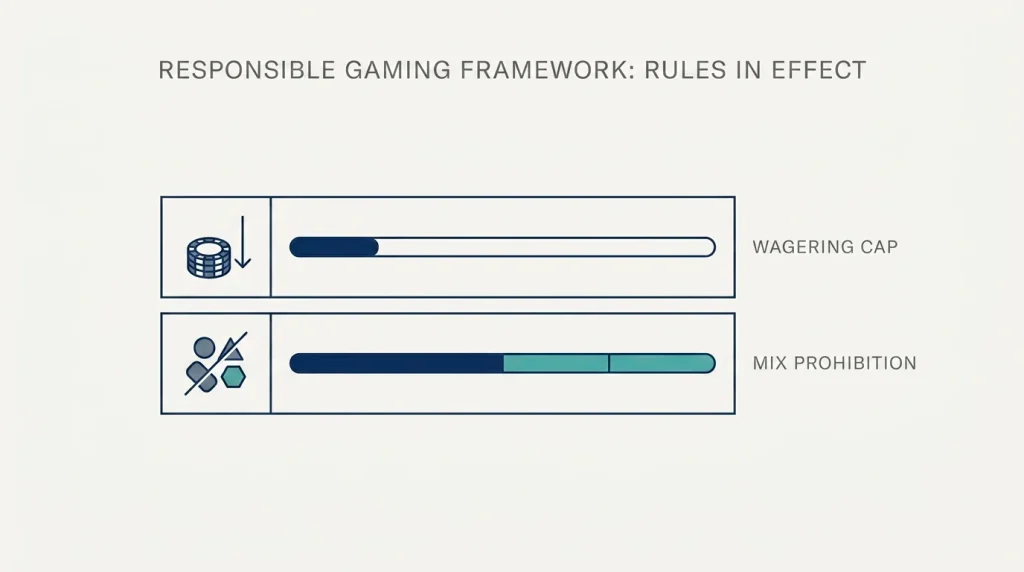
None of that applies offshore. The structural reason the headline percentages look bigger at non-GamStop casinos is that the offshore segment is not subject to either the 10x cap or the mixed-product prohibition. That fact is the entry point into the rest of this page.
What bonus structures appear at non-GamStop casinos?
Five recurring structures account for most of the offers visible in the segment. The welcome match, the free-spins package, the no-deposit bonus, the reload, and the loyalty or cashback programme. Each has its own behavioural profile and its own pitfalls.
Welcome matches typically run from 100 per cent to 400 per cent of the qualifying deposit, occasionally as high as 500 per cent on crypto-only deposits. The sector-level average measured across the visible offer set sits at approximately 137 per cent up to a £520 ceiling. The headline figure is the most visible variable; the wagering multiplier, the max-bet cap during wagering and the game weighting are the variables that actually determine whether the offer is recoverable as cash.
Free-spins packages range from 50 to 300 spins, typically attached to a specific slot or set of slots, with per-spin values from £0.10 to £0.20. The winnings from free spins are usually treated as bonus funds subject to wagering, not as cash. No-deposit bonuses appear less frequently but persist; they typically range from £10 to £25 in bonus credit, with wagering of 40x to 60x and maximum cashout caps from £50 to £100. Reload bonuses, the weekly or monthly top-up offer, sit at 25 to 50 per cent matches with tighter caps. Loyalty programmes vary widely; cashback in the 5 to 15 per cent range on net losses appears at the more established operators.

How do wagering requirements actually work?
The wagering multiplier defines the minimum total turnover, in real money equivalent, that must be wagered before the bonus and any winnings tied to it become withdrawable. The multiplier applies to the bonus amount only in some operator terms, to the deposit plus bonus in others; the difference doubles the effective turnover requirement.
Offshore norms cluster between 30x and 50x of the bonus amount, with some crypto-specific bonuses as light as 1x to 10x. Compared against the 10x UKGC cap from 19 January 2026, the gap is material: a £100 bonus at 35x wagering at a non-GamStop operator demands £3,500 of turnover before withdrawal, against £1,000 at a UKGC licensee.
Several other terms attach to that headline multiplier and modify it materially.
- Max bet during wagering
- Typically £2.50 to £5 per spin or per hand. A bet exceeding the cap voids the bonus and any associated winnings, even if the cap is exceeded inadvertently by a single click.
- Max win cap
- A multiplier on the bonus amount, commonly 10x or 20x, that limits the maximum withdrawable amount derived from the bonus. A 10x cap on a £100 bonus caps cashout at £1,000 regardless of any larger balance accumulated.
- Game weighting
- Slots commonly contribute 100 per cent to wagering turnover, live casino games 10 to 20 per cent, table games such as roulette and blackjack 5 per cent or zero. A £100 wagered on roulette at 5 per cent counts as £5 toward the multiplier.
- Game restrictions
- Specific high-RTP slots or jackpot slots are commonly excluded from bonus play entirely; bets on those games during an active bonus period void the bonus.
- Expiry
- Bonuses expire in 7 to 30 days from credit; unfinished wagering on expiry forfeits remaining bonus funds and tied winnings.
What does the maths look like in practice?
A worked example clarifies what the structure produces. Take a stylised but typical offshore welcome offer: a £100 deposit attracting a 200 per cent match, producing a £200 bonus, with 40x wagering on the bonus, slots-only weighting at 100 per cent, maximum bet during wagering £2.50, expiry 14 days.
Required turnover: 40 multiplied by £200, equals £8,000 of slot wagering. At a per-spin bet of £2.50, that is 3,200 spins of compliant play. Most slot games run at 600 to 900 spins per hour. Compliant clearance of the wagering therefore requires roughly four to five hours of continuous slot play.
The expected value of that turnover at a typical slot RTP of 96 per cent is a theoretical loss of 4 per cent of total turnover, or £320. The deposit-plus-bonus stake going in is £300. The expected outcome of clean wagering completion is therefore a £20 net loss against the starting deposit, before any variance. Variance can produce either a meaningful win or a complete bankroll burnout before wagering completion; the £20 figure is the central tendency, not the typical experience.
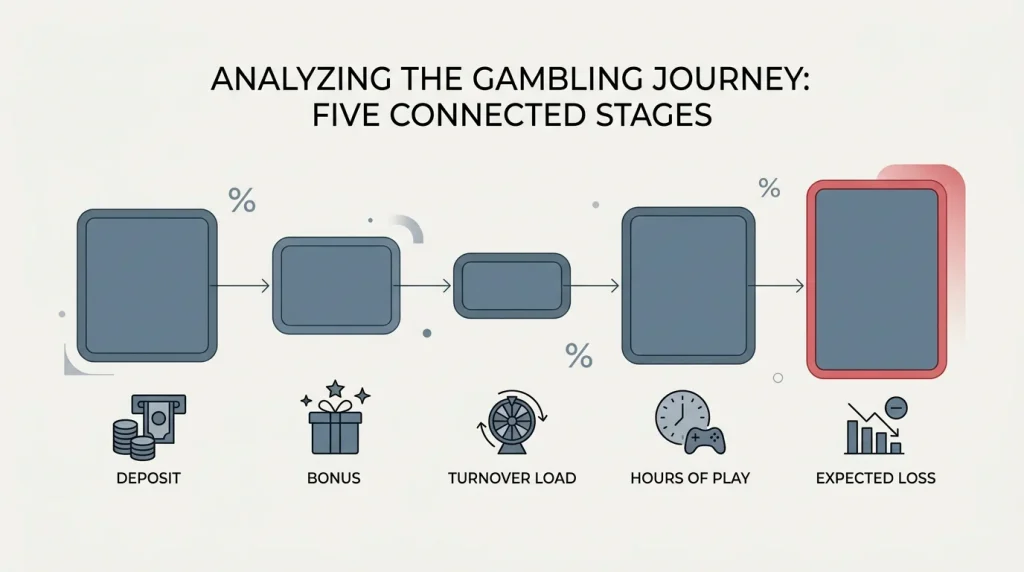
Substitute a 30x wagering multiplier and the required turnover drops to £6,000 with proportionally lower expected loss. Substitute a UKGC 10x cap on the same notional offer and the required turnover falls to £2,000, with expected loss of £80 against the deposit, an entirely different proposition. The wagering multiplier is the single most important number in the bonus T&Cs; the headline match percentage is the second.
How do payment methods interact with bonus terms?
Operators commonly exclude specific payment methods from welcome bonus eligibility. Skrill and Neteller deposits are excluded at a substantial proportion of non-GamStop sites; bank-transfer deposits are sometimes excluded; in some cases only the first deposit on a single card or wallet counts. Cryptocurrency deposits sometimes carry their own parallel bonus tier with different wagering. The wider interaction is set out in deposit-channel bonus mechanics.
Bonus disputes are the area where the absence of a UK Alternative Dispute Resolution route bites hardest. A retroactive bonus-term enforcement (for example, a max-bet violation flagged at the withdrawal stage, three weeks after play, with the entire bonus and tied winnings voided) sits outside IBAS jurisdiction. The wider regulatory gap is documented on the wider risk picture, including bonus-dispute case patterns.
How much do bonus terms vary across operators?
Variation is substantial. The same headline 200 per cent match can carry 35x wagering at one operator and 50x at another, with materially different max-bet caps and max-win multipliers. Sister-site networks tend to share underlying terms across brands, which can be a useful diagnostic; if four operators with different branding share identical bonus T&Cs to the letter, they are likely operating under a single back-office structure. The mapping of those networks is covered on the operators offering these bonus structures page.
For readers who want to assess a specific offer rather than the segment in aggregate, three terms read carry roughly 80 per cent of the practical risk: the wagering multiplier, the max-bet cap, and the game-weighting table. The fourth, often overlooked, is the maximum cashout cap, which can be the difference between a profitable bonus and a no-recovery one regardless of how lucky the player gets.
What is the harm-reduction angle on bonus play?
Bonus structures with high wagering multipliers, time pressure from expiry windows, and restrictive game weighting concentrate play into longer sessions on faster-paced products, which is the behavioural profile most associated with harm escalation in UK research data. The UKGC 10x cap and the mixed-product prohibition under SRCP 5.1.1 are deliberate responses to that profile.
For readers who recognise that bonus chasing is part of a wider pattern of difficulty in their gambling, the UK support pathway is direct and free at the point of access. Detailed routes are on UK support resources; the headline number is GamCare’s 24/7 helpline on 0808 8020 133.
How should a UK reader practically frame a bonus decision?
Three steps reduce avoidable surprise. First, read the wagering multiplier before the headline percentage; the multiplier is the load and the percentage is the load distribution. Second, calculate the required turnover (multiplier multiplied by bonus amount, or by deposit plus bonus if the terms specify both) and divide by an honest typical bet size to estimate playing volume required. Third, check the max-win cap; a bonus is only worth what the cashout cap allows you to withdraw, not what the visible balance suggests.
Bonus value follows the wagering arithmetic. It does not follow the headline percentage. Once the arithmetic is on the page, the decision becomes a clear one rather than a marketing one, and that is the entire point of taking the time to work through the T&Cs before depositing.
The full picture is in our guide to casinos not on GamStop.
What is missing behind the offer: the lost protections.
Recommend
Created by the "Casino Not on Gamstop" editorial team.