
Crazy Time Live Casino Game Show in the UK
 Available in GB
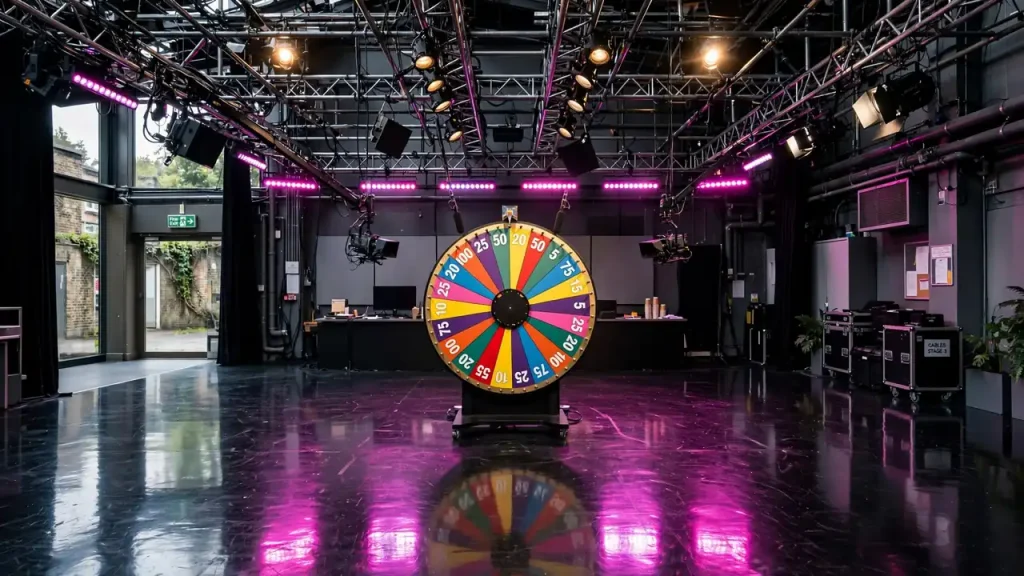
A practical guide to the live show format, UK casino checks, account controls, stake limits, demo access and bonus conditions.
What Crazy Time Is—and What the Live Show Adds
Crazy Time is a live casino game show built around a studio presentation rather than the visual language of a conventional online slot. It is associated with Evolution and appears as a hosted product in the live-casino category. The distinction matters because the word “casino” covers several very different formats: a slot runs through software-led reels, while a live game places a presenter, a broadcast set and a visible studio performance at the centre of the session.
That does not make it television in the ordinary sense. The show is connected to a gambling interface, so the screen combines the live feed with the controls needed to select a wager and follow the outcome. The presenter’s role is part of the experience, not a promise that the result can be influenced by conversation or timing. From the operator’s side of the counter, that separation is important: production creates atmosphere; it does not turn a gambling product into entertainment with no financial risk.
A live format, not a renamed slot
Searches for a Crazy Time casino in the UK can lead to descriptions that blur the boundary between a game show and a slot. The labels may sit close together in a casino menu, but the products are not interchangeable. A slot is normally presented as an automated sequence of software-generated game cycles. Crazy Time is presented as a live casino broadcast, with a host guiding the session and the interface organising participation around what is shown on screen.
Casino Games: Slots, Table Games and Live Play · Chicken Road Game Casino UK: What the Label Means
The practical effect is a different rhythm. Instead of treating the display as a set of reels to start and stop, the player follows a hosted event as it develops. Sound, camera work and studio presentation are therefore functional parts of the product’s identity. They are not evidence of a better chance, a guaranteed result or a safer wager.
I have seen “live” used as an advertising shortcut for almost anything with a video window. That is why the label should be read narrowly here. A real live-casino presentation means the show format is central to the product, not merely added decoration around an otherwise standard slot.
What the show adds
The live element adds a social and visual layer that software-only casino games do not provide in the same way. There is a presenter, a broadcast environment and a shared sense of a scheduled event. That can make the session feel more immediate, but immediacy is not a financial advantage. The interface still represents a real-money gambling decision where a wager is made.
Crazy Time live casino sessions should consequently be understood on two levels. The first is the programme: a hosted game-show presentation designed for continuous viewing. The second is the gambling account behind it, where the selected wager and the resulting outcome are recorded by the operator. Confusing those levels is where promotional language does its quietest work.
The useful starting point is simple: Crazy Time is a live casino game show, not a conventional online slot wearing a studio backdrop. Its appeal comes from presentation, pacing and the feeling of joining a broadcast. The sensible boundary remains equally simple—only gamble what can be afforded to lose.
Format Live casino game show
Provider Evolution
Category Live games / Game shows
Top online casinos in the UK
- Revery PlayBonus: 100% up to€1,000+ 100 FS · Payout speed: 1-3 business days
- ChanzeBonus: Slots Welcome Bonus #1 200% up to €500 · Payout speed: 1-3 business days
- SlotoSportBonus: 500% up to £ 10 200+ 777 FS · Payout speed: 1-3 business days
- AmunbetBonus: Join now and get 450% up to 2,700 GBP + 450 FS · Payout speed: 1-3 business days
- NightLuckBonus: Welcome Pack + 805% Up To 6400€ + 280 FS · Payout speed: 1-3 business days
- BritsinoBonus: Welcome Package – Get your £2,200 + 2,000 FS · Payout speed: 1-3 business days
Where Crazy Time Sits in a UK Live Casino Lobby
Crazy Time is normally located in the live casino area rather than among conventional online slots. That distinction matters because a lobby may divide its catalogue by format first, then by game family, provider or table availability. The title can therefore be absent from the first screen without being unavailable in the wider live section.
The quickest route is usually the lobby’s category structure. Look for labels such as Live Casino, Live Games or Game Shows, then use the catalogue search if one is provided. Searching for “Crazy Time” is more reliable than scanning every tile, particularly where the lobby contains several versions of roulette, blackjack and other table games. A result labelled as a live game show should not be confused with a similarly named slot or promotional banner.
Placing the title among other live games
A live casino lobby may group games by the type of experience rather than by a formal ranking. Crazy Time can sit near wheel-based or game-show products, while card and roulette tables appear in adjacent categories. The neighbouring titles may include:
- Crazy Time
- Dream Catcher
- Common Draw
- Lightning Roulette
- Infinite Blackjack
This is a catalogue reference, not a quality order. Placement on the page does not establish that one title is more popular, more suitable or more rewarding than another. In my experience, “featured” often means that a lobby has chosen to give a tile more visibility, not that the game has an independently verified advantage.
The same title may also appear under more than one filter. A lobby could show it in a general live-casino view and again under game shows or wheel games. Filters can be labelled differently between desktop and mobile versions, so the absence of one category does not necessarily settle the question. The title, thumbnail and game description provide the more useful confirmation.
Why the lobby layout can change
Live-casino menus are commercial interfaces, not fixed directories. Operators may rearrange tiles, hide games when tables are unavailable or display a separate entry for a particular studio feed. A “play now” button can also lead to a lobby page before a table or game instance is selected. That is a navigation detail, not evidence that the title itself has changed.
Crash Casino Games in the UK: How They Work
The game may be listed as Crazy Time, Crazy Time Live or under a broader game-show heading. The wheel image is a useful visual clue, but it should not be treated as proof of the exact product. Names, artwork and table labels should match before the game is opened.
A practical check is to inspect the game tile and its information panel together. The tile identifies the product; the information panel may show whether it is live, which access mode is available and whether the current lobby has an active table. Those details are more dependable than a banner describing the wider casino.
Grosvenor illustrates why a live lobby can contain several distinct formats. The operator introduced its live casino offering in 2013 with card and casino games including Blackjack, Texas Hold’em and Roulette. Crazy Time belongs in that broader live-casino environment, but its position beside those titles should not be read as a ranking. It is simply another route through the live catalogue.
French Roulette Online Casinos in the UK: Rules
Choosing a Casino for Crazy Time: Check the Licence First
A casino can display Crazy Time prominently and still require a separate check before any deposit is made. The game’s live presentation says something about the product; it does not establish that the operator may lawfully offer remote gambling to customers in Great Britain. That authorisation belongs to the business running the account, payment process and customer support.
I have seen the game title become the centre of a landing page while the operator’s status is left in a footer, behind a generic badge or under a different company name. That is the wrong order of inspection. For Crazy Time casinos in the UK, the first question is not whether the table looks polished. It is whether the business can be matched to a current Gambling Commission operating licence.
Why the operator’s licence comes first
The UK Gambling Commission oversees gambling activity in the United Kingdom, including online casino operations. For commercial gambling in Great Britain, it is the regulator with responsibility for the sector. A remote operator serving customers in Great Britain must hold the relevant authorisation even when its technical equipment, corporate office or game infrastructure is located elsewhere.
Do
- Match the casino brand to the Gambling Commission public register
- Confirm the domain used for the account is listed under the licence
- Verify the legal operator’s name and trading brand
Don’t
- Assume a provider like Evolution makes a casino licensed
- Rely on a visual logo or banner as proof of regulation
- Trust an offshore description as a replacement for UK authorisation
That point matters because a casino may describe itself as international, offshore or powered by a supplier based abroad. None of those descriptions replaces the authorisation required for remote gambling offered into Great Britain. The location of the game server is not the deciding test.
The legal status attaches to the operator, not to Crazy Time itself. Evolution may provide a live game, but the supplier’s involvement does not turn an unverified casino into a licensed one. The same applies to a casino using a familiar payment method, a recognised visual identity or a well-known live-dealer format. These are commercial features, not proof of regulatory permission.
The practical rule is simple: identify the legal business behind the casino, then confirm that business on the Commission’s public register.
Match the casino to the public register
A proper licence check is more exact than looking for a logo. The register should be used to compare the details shown by the casino with the details recorded by the regulator.
The checks should cover:
- the operator’s legal name, not only its trading brand;
- the website domain used for the Crazy Time account;
- the type of operating permission recorded for remote gambling;
- the current status shown in the register;
- any relationship between the brand, domain and licensed business.
A brand can trade under a name that differs from its corporate entity. That is not automatically a problem, but the connection must be clear. If the casino supplies a licence number, it should lead to a register entry that identifies the same authorised business or explains the brand relationship. A number copied into a footer without a corresponding record is not useful evidence.
The domain matters as well. A register entry for one website does not automatically validate every other domain using similar colours, wording or branding. The account page, deposit page and terms should all point to the same authorised operation. Where they do not, the gap deserves attention before registration.
A common mistake is to check only whether a brand name appears somewhere in a search result. That can produce false confidence: similar names may belong to different businesses, and an old reference may no longer describe the current site. The register is the relevant point of comparison.
Online Casino Games for Real Cash in the UK
The date of a register check matters
Regulatory information is not a permanent badge. A register entry can change, and a page copied into a review can remain online after the underlying position has changed. For that reason, a licence check should be treated as a dated decision rather than a fact remembered from an earlier visit.
A specialist affiliate review dated 26 September 2026 reported that the public Gambling Commission register did not show a LuckyPays entry under the LuckyPays brand or its stated domain, including luckypays.io. That is a time-specific finding about the register, not a general statement about every casino using a similar name and not a substitute for checking the live record before depositing. The useful lesson is the method: brand, domain and register entry must correspond.
I would not rely on a banner saying “UK licensed” when the business name cannot be located in the register. Nor would I treat a review’s description as current merely because it appears detailed. The status needs to be checked at the point when the account is being considered.
Licence Check
- Match the operator’s legal name to the public register
- Confirm the website domain is authorised
- Verify the type of operating permission held
- Check the current status of the licence
What the licence check protects
The authorisation check is not just a formality. It identifies the regulatory framework applying to the account relationship. A licensed operator must operate within the requirements attached to its Gambling Commission permission, including the systems used for customer verification, complaints and responsible gambling.
The Commission issues operating licences to businesses and personal licences to individuals involved in operating gambling businesses in Great Britain. These are different permissions. A casino’s public claim that its staff or managers hold a personal licence does not by itself prove that the website has the necessary operating licence. The business offering the remote casino service is the part that must be matched first.
A valid operator check also gives a clear route for examining the site’s published information. The casino should identify its legal entity, licence details, terms, complaints procedure and responsible-gambling arrangements. If those details are scattered, contradictory or difficult to locate, that is a practical warning sign even before the game lobby is opened.
This is where advertising language can mislead. “Trusted” often means that the page has been designed to look familiar. “Secure” may refer only to connection technology. “Licensed” should mean something narrower: a specific business holding the relevant Gambling Commission authorisation for the service being offered.
Strip away the label.
Do not confuse provider credibility with casino authorisation
Crazy Time is a product supplied to operators; it is not the licence-holder for the customer’s account. A recognised provider can improve confidence in the identity of the game, but it cannot answer questions about withdrawals, account restrictions or complaints against the casino.
Provider Role
Evolution provides the live game, but they are not the licence-holder for your gambling account. The casino operator is responsible for your withdrawals, account restrictions, and complaints.
The distinction is important when comparing online casinos offering Crazy Time. One site may list the title alongside other Evolution games, while another may present a similar live lobby. The presence of the same supplier does not make the operators equivalent. Each casino remains responsible for its own customer relationship and must be assessed separately.
The same principle applies to a casino group. A group may operate several brands, but a licence check still needs to establish which legal entity serves the particular domain being used. A familiar parent-company name is not enough if the terms name another operator or the register does not connect the brand with the site.
Read the operator’s own legal information
The register is the primary external check, but the casino’s own pages should make the comparison possible. The following details should be consistent across the footer, terms and account pages:
- the legal operator’s name;
- the trading brand;
- the website domain;
- the Gambling Commission licence information;
- the complaints and dispute route;
- the responsible-gambling information.
A mismatch does not prove misconduct by itself. Corporate structures can be complicated. It does mean that the relationship needs explaining before money is placed in the account. If the operator avoids naming the legal business, uses only a mailbox, or presents a licence claim that cannot be matched, there is no sound basis for treating the site as a licensed UK casino.
A casino’s complaints process is also worth locating before registration. UKGC licensees must provide an internal route for complaints and access to an approved Alternative Dispute Resolution service. That does not guarantee that every disagreement will be resolved in the customer’s favour. It does mean that the operator should explain how a complaint moves beyond ordinary support if it remains unresolved.
How to compare several Crazy Time casinos
Once the licence position has been established, the comparison can move to matters such as the game lobby, account terms and service arrangements. The order is deliberate. A polished lobby is not a substitute for authorisation, and a welcome message is not a substitute for a clear legal identity.
For each candidate, a short record is more reliable than memory:
| Check | What to establish |
|---|---|
| Operator | Which legal business runs the account? |
| Domain | Does the registered information relate to the website being used? |
| Licence | Is the relevant operating authorisation visible on the public register? |
| Brand link | Is the trading name connected clearly to the licensed entity? |
| Complaints | Are the internal and ADR routes explained? |
| Account information | Are the terms and responsible-gambling pages accessible? |
This approach avoids producing an unsupported list of “best” Crazy Time casinos. There is no meaningful ranking until the basic eligibility of each operator has been established. A site that offers the desired game but cannot be matched to the register should not be placed beside a verified operator as though the two were simply different styles of casino.
The register check is the gate, not the final verdict. After that, the account conditions still need to be read carefully: age verification, deposits, payment methods, limits and controls determine how the account can actually be used. Those are separate operational questions, and they should not be inferred from the presence of a licence badge or a live game title.
Playing Crazy Time Online: Deposits, Limits and Account Controls
A Crazy Time account is not opened by depositing first and sorting out checks later. For a UK-facing online casino, age verification must be completed before the operator allows funds to be deposited into the gambling account. That check is part of account access, not an optional security step added after registration.
Casino Dice Games in the UK: How They Work
The same distinction matters when a site presents a quick sign-up form. Creating login details does not necessarily mean that the account is ready for real-money gambling. The operator may still need to verify identity and age before accepting a deposit. In my experience, this is where the wording on a registration page matters: “instant access” can mean access to the account area, not permission to fund it.
Depositing for online play
Payment methods are also restricted. UK-licensed casinos cannot accept credit cards for gambling. The restriction extends to credit-card funding routed through a money service business, and a wallet cannot be used where its balance contains credit-card funds intended for gambling.
That removes a common assumption about casino deposits: seeing a familiar payment logo does not mean every funding route is permitted. A payment account may support several funding sources, while the gambling operator must still prevent a prohibited credit-funded transaction. The relevant question is not simply whether a method appears in the cashier, but whether the money originates from an allowed source.
Payment Restriction
Attention UK-licensed casinos cannot accept credit cards for gambling purposes.
A deposit page should make the available method, processing status and account balance clear. If a transaction is declined, the reason may relate to the funding source, identity checks or the operator’s own account controls. Repeated attempts do not resolve those issues and can make the account record harder to interpret.
Financial limits before the first deposit
Remote gambling operators must prompt new customers to set a financial limit before the first deposit. The account must also provide accessible controls for changing or reviewing limits. This is intended to put a boundary around account funding before play begins, rather than relying on a customer to impose one after spending has already taken place.
The control may be presented as a deposit limit or another account-level financial setting, but the practical point is the same: the limit belongs to the account, not to a particular round or session. It should be possible to find it without searching through promotional pages or contacting support.
A change to a financial limit may not operate in the same way in every direction. The account interface and its terms should explain when a reduction takes effect and how an increase is handled. That wording deserves attention before a deposit is made. “Flexible” can mean easy to raise, while the useful protection is often the ability to impose a lower boundary and leave it in place.
Deal or No Deal Casino UK: Slots and Game Formats · JetX Casino Game in the UK: How It Works
The game itself does not replace these controls. A live table can make spending feel continuous because the presentation moves from one round to the next. The account limit remains the more important reference point.
Responsible-gambling tools
UK-licensed casinos must provide responsible-gambling tools, including self-exclusion. These controls should be available through the account or clearly explained by the operator. They are not decorative links in the footer: they determine what happens when ordinary limit-setting is no longer sufficient.
Self-exclusion is a stronger intervention than a temporary pause. It is designed to prevent gambling access for the selected period or arrangement described by the operator. Account closure, a deposit limit and self-exclusion should therefore not be treated as interchangeable options. Each changes the account in a different way.
Operators must also provide an internal complaints process and access to an approved Alternative Dispute Resolution service. This applies to account problems as well as other gambling-related disputes. The complaints route should identify how a complaint is submitted, what information is required and how escalation works if the internal response does not resolve the matter.
I treat those pages as part of the cashier, not as legal background. Before money enters an account, the useful checks are straightforward:
- age verification is complete;
- the proposed payment method is not credit-funded;
- the financial limit is set and visible;
- responsible-gambling controls can be located;
- the complaints and ADR routes are available.
Only money that can be afforded to lose should be used for gambling. If control over spending is becoming difficult, further deposits are not a solution; self-exclusion and specialist support are the appropriate account-level responses.
Crazy Time Stake Limits: A Slot Label Does Not Set the Rules
A search for a Crazy Time casino strategy can easily lead into the wrong regulatory question. The important point is not the word “casino” in the title, nor the fact that the game appears in an online casino lobby. The relevant issue is how the product is classified for stake-limit purposes.
The Great Britain limits described in a specialist review apply to online slots by game cycle:
- Adults aged 25 and over: no more than £5 per game cycle
- Adults aged 18 to 24: no more than £2 per game cycle
Those figures are age-based limits for online slots. They are not a general ceiling for every game displayed by a casino. A live casino product does not become a slot merely because it is available through casino software, has a studio presentation, or appears beside slot titles.
That distinction matters when assessing a Crazy Time live casino strategy. A strategy may concern how a player approaches the game, but it cannot determine the legal category of the product or change a stake restriction. Nor can a tracker—whether described as a Crazy Time tracker, casino tracker, or a record of previous outcomes—turn a live game into an online slot. Tracking information is not a classification decision.
The same separation applies to casino history. Crazy Time’s place in the history of online casino entertainment and its presentation as a live game do not, by themselves, answer the stake-limit question. Product branding is not the rulebook.
UK Slot Limits
For online slots, adults aged 25 and over are limited to £5 per game cycle, while adults aged 18 to 24 are limited to £2 per game cycle.
Note that these specific limits apply to online slots and may not apply to live casino products like roulette or blackjack.
A specialist review also states that the Great Britain slot limits do not apply to roulette or blackjack. That is why comparisons with Lightning Roulette or Infinite Blackjack need care: the presence of a wheel, cards, a host, or a streamed table points towards the nature of the product, but the definitive treatment should come from the operator’s published information and the applicable regulatory framework. It is unsafe to infer a limit from a familiar casino label.
The practical check is therefore straightforward:
- Identify whether the product is being offered as an online slot or as a live casino game.
- If it is an online slot, apply the relevant age-based limit for the player’s age group.
- If it is roulette or blackjack, do not apply the slot cap simply because the game is accessed online.
- Treat the product description, rules and account information as separate from any personal staking method.
This also explains why searches for Crazy Time casino game strategy and Crazy Time casino strategies often produce advice that has little to do with regulation. A staking system may discuss patterns, session budgets or outcome tracking, but those subjects do not establish what limit applies. I have seen “strategy” used as a broad label for everything from game-selection notes to a betting record. It is not a substitute for classification.
Whatever the category, gambling money should be limited to what can be afforded to lose. A strategy cannot remove that risk.
Free Play and Demo Access: What to Confirm Before Starting
A search for a free way to play Crazy Time can mean several different things. It may refer to a demonstration mode, a preview available before registration, a promotional reward, or simply a wish to watch the live table without wagering money. Those are not interchangeable. A page labelled “free play” may show the game interface while leaving the real-money table, account requirements and available features subject to separate conditions.
I have seen the word “free” used rather loosely in casino marketing. Sometimes it means that no deposit is needed to open a demonstration screen. Sometimes it describes bonus funds that remain conditional until the promotion’s rules are met. Sometimes it is only a short viewing opportunity. The label alone does not establish what access is actually provided.
What a genuine demo should make clear
Before treating a Crazy Time demo as a free casino game, the page should explain the access mode in plain terms. The important points are:
- whether registration is required;
- whether a deposit is required;
- whether any money can be won or withdrawn;
- whether the screen uses simulated funds;
- whether the demonstration is the same product as the live-money version;
- whether access is limited by device, location or account status.
A demo that uses virtual credits is useful for becoming familiar with the layout and basic controls. It is not evidence that a casino has accepted a real-money account, and it does not turn a promotional page into a licensed gambling service. The distinction matters because promotional wording often puts the attractive part in the headline and leaves the access conditions below it.
The same caution applies to claims about free spins. Crazy Time is a live casino game show rather than a conventional online slot, so a reference to “free spins” needs checking rather than automatic acceptance. It may describe a casino-wide promotion, another game in the lobby, or a reward with conditions attached. The phrase does not by itself prove that free participation in Crazy Time is available.
Free viewing is not free wagering
Some pages use “watch live” and “play free” as though they were the same thing. They are not. Viewing a stream, opening an information page and entering a demo mode each provide a different level of access. None should be assumed to offer a way to wager without an account or without meeting the operator’s conditions.
Demo Access
Free play or demo modes should be used to understand the interface, but they do not constitute permission to wager or deposit funds.
For real-money play in Great Britain, the operator must verify a customer’s age before allowing a deposit. That requirement sits at the account level; a demonstration mode should not be confused with permission to deposit or wager. If a site moves from a free preview to a payment screen, its account, identity and financial controls become relevant before play for money begins.
A “safe” free-play page should therefore be judged by what it explains, not by the word safe in its title. Clear ownership, identifiable terms, a visible route to the operator’s regulatory information and an honest description of the access mode are more useful signs than a large promotional badge. I treat unexplained redirects, pressure to deposit and unclear virtual-credit balances as reasons to stop.
A short check before opening the table
The practical check is simple:
- Establish whether the mode is demonstration, viewing or real-money play.
- Confirm whether registration or a deposit is required.
- Read what happens to any displayed balance.
- Check whether the offer concerns Crazy Time itself or another casino product.
- Leave the page if the terms are missing or the route to the operator is unclear.
Free access can be useful for understanding the presentation without financial exposure. It should not be treated as proof of a casino’s suitability, and it should never encourage spending beyond what can be afforded to lose.
Bonus Terms Around Crazy Time: Read the Deposit Conditions
A casino welcome bonus is not a general discount on every game in the lobby. It is a contractual offer attached to stated conditions, and the headline wording rarely tells the whole story. For Crazy Time, the important question is whether the promotion permits wagering on the intended game, rather than whether the casino advertises a bonus beside its live casino section.
The terms should be checked before making a deposit. Key points include:
- which customers qualify, including any new-account or selected-payment requirements;
- whether the offer requires a qualifying deposit;
- which games contribute to the promotion;
- whether live casino games, including Crazy Time, are excluded or treated differently;
- how winnings from bonus funds may be released;
- whether the promotion has an expiry condition;
- which withdrawal or account-verification conditions apply.
The distinction between “eligible” and “contributing” matters. A game may be permitted while contributing nothing towards the conditions, or it may be excluded altogether. A promotional page can use broad language such as “casino games” while the detailed terms narrow that description in a separate section. That is where the operative wording sits.
I have seen players read the banner, fund the account, and only then discover that their chosen live game does not count for the promotion. The problem is not necessarily the game; it is the mismatch between the advertising label and the bonus rules. Read the exclusions.
A deposit bonus also does not automatically mean that every amount shown in the balance is immediately withdrawable. Promotional funds, associated winnings and deposited funds may be handled under separate conditions. The account rules should explain what happens when a withdrawal is requested before the promotion is completed or cancelled.
Are free spins always available for Crazy Time?
No, a reference to free spins may describe a casino-wide promotion or another game, rather than guaranteed free participation in Crazy Time.
Can I use a bonus for Crazy Time?
You must check the specific bonus terms, as many live casino games are excluded from certain promotions or contribute differently to wagering requirements.
Searches for a Crazy Time casino bonus, a no-deposit offer or a UK welcome promotion all lead to the same practical check: locate the full terms, confirm that the offer is available to the relevant account, and verify the treatment of the intended live game. “No deposit” is not a synonym for unrestricted play, and “bonus payouts” are not a promise that a particular outcome or withdrawal will be available.
If the wording is unclear, the safer decision is to leave the promotion unused rather than deposit on an assumption. Any gambling account should also be used only with money that can be afforded to lose.
Rules, Multipliers and the Difference Between a Show and a Slot
Crazy Time rules should be read from the game’s own rules panel or the operator’s published help page. That is where the relevant terminology, round sequence and available choices are defined for the version being offered. A general casino description is not a substitute: it may compress the explanation or use promotional language.
Mines Casino Game UK: How Online Play Works
The same applies to searches for Crazy Time multipliers. The word “multiplier” describes a feature or value only when the stated rules explain what it applies to and when it can affect an outcome. It does not, by itself, establish a guaranteed return, a minimum result or a particular way of calculating a payout. I have seen attractive figures separated from the conditions that give them meaning. The missing sentence matters more than the large number.
“Scores” can also be misleading. In a live casino game show, a score may refer to an on-screen result, a recorded outcome or a value displayed during a round. It should not automatically be read as a slot-style win meter or as evidence of a fixed payout. The rules and table information should define the term.
Crazy Time is therefore best approached as a live game show rather than an online slot. A slot normally presents a reel-based game cycle, while a live show is built around a streamed presentation and an outcome governed by its published game rules. Similar casino language does not make the products interchangeable.
A trusted Crazy Time casino is not established by a multiplier graphic or a scores page. Trust rests on the operator’s regulatory position and the clarity of its game information. Gameplay wording comes second. Clear rules first.
What are the online slot stake limits in Great Britain?
The limit is £5 per game cycle for adults aged 25 and over, and £2 for adults aged 18 to 24. These limits do not apply to roulette or blackjack.
Are online casino games licensed and regulated?
Yes. The UK Gambling Commission regulates remote gambling offered to consumers in Great Britain, and operators serving them must hold the relevant licence.
Is LuckyPays licensed by the UK Gambling Commission?
The public Gambling Commission register dated 26 September 2026 does not list LuckyPays under its brand or stated domain, including luckypays.io.
Casino Games
Created by the "Casino Not on Gamstop" editorial team.