
Progressive Slots Online UK: How Jackpot Pools Work
 Available in GB
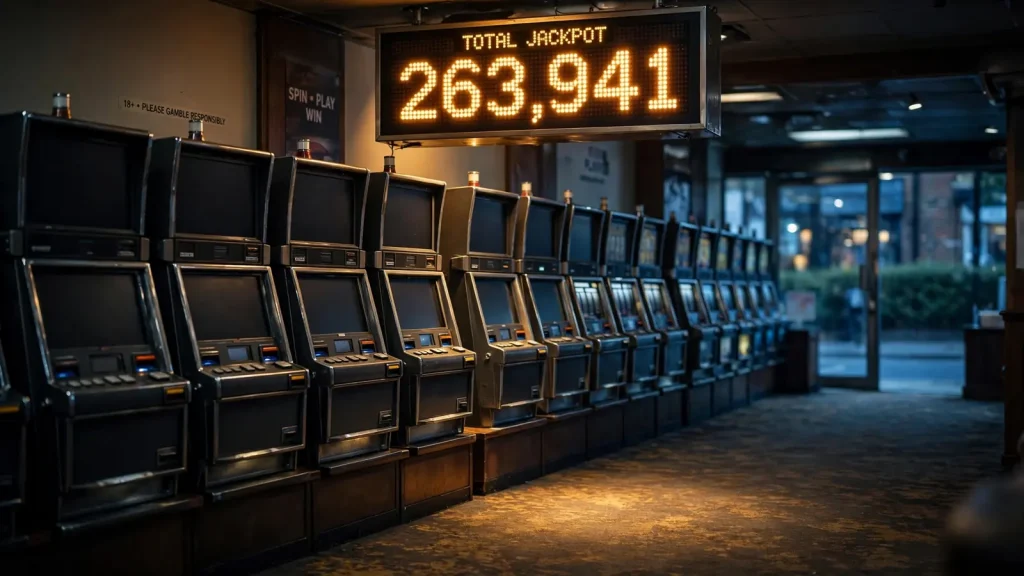
See how linked pools grow, what can trigger a jackpot, and how progressive slots differ from fixed-prize games.
How Progressive Jackpot Pools Build
A progressive jackpot is funded differently from a fixed prize attached to one slot. The prize meter is connected to a wider system, and qualifying wagers made on linked machines feed that system as play takes place. The amount displayed on screen can therefore rise while the game remains available, rather than staying at a preset value.
The underlying process is straightforward. A player starts a spin on a connected progressive slot, the wager is processed by the game system, and a defined share is directed towards the associated jackpot pool. The remainder supports the operation of the base game and its ordinary prizes. Each individual contribution may be small, but wagers from many connected machines accumulate in the same account.
That distinction matters when comparing progressive slots online in the UK with ordinary online slots. In a standard slot, the stake is dealt with inside that particular game’s mathematical model. In a progressive slot, part of the stake also has a separate destination: the growing prize pool. The meter is not simply a marketing counter placed beside the reels. It reflects money being added through connected play.
How much of a wager feeds the pool?
The contribution assigned to the jackpot is commonly between 1% and 3% of each wager. The exact percentage belongs to the game’s design and its operating arrangement, so it should not be assumed that every progressive penny slot in the UK uses the same allocation.
A modest stake can still make a contribution because the calculation is applied across connected wagers. “Penny” in a game description generally refers to the denomination or small unit used for the slot’s stake structure; it does not mean the jackpot is funded by one isolated machine. A progressive penny slot online in the UK may be linked to a much broader pool, depending on how the provider has configured the network.
This is where promotional wording can blur the economics. “Every spin builds the jackpot” sounds personal, as though one account is accumulating its own private prize. In practice, the contribution joins a shared balance. The player’s wager adds to the pool, but so do qualifying wagers placed elsewhere on the same connected system.
Small slice, wide network.
Slots: UK Casinos by Game Provider and Type
From individual spin to shared balance
The pool is built from wagers made on connected slot machines. Those machines may be online games presented through different casino brands, provided the same progressive slot and its associated network are being carried. The system recognises the common game connection and routes the relevant contributions into the linked jackpot account.
This explains why a jackpot can grow faster than the activity visible in one online casino. A single operator may show only its own customers using the game, while the progressive meter reflects activity across the wider network. The displayed total is therefore not a report of one site’s betting alone.
The arrangement also changes how the jackpot should be understood. It is not necessarily a prize reserved for customers of the operator where the highest meter happens to be visible. Where multiple operators carry the same connected progressive slot, wagers across those operators can contribute to one shared pool. The game connection, rather than the branding of the casino page, determines the relevant network relationship.
That does not mean every slot with the same theme belongs to one pool. The important link is the connected progressive game itself. A similar title, a different version, or a separate casino release may use an entirely different prize structure. The name on the reels is not enough to establish that the games share a meter.
Why the meter keeps moving
A progressive meter rises because new connected wagers continue to direct their designated contributions into the pool. It can move at a different pace from the number of visible players on one site, since the network may include games hosted by other operators. A quiet lobby is not proof that the wider jackpot system is inactive.
The same mechanism applies whether the game is described as a progressive slot, an online progressive slot, or one of the newer progressive slots added to a catalogue. The label identifies a prize that accumulates through linked play; it does not by itself reveal the size of the network or the contribution percentage.
From an operational perspective, the pool is separate from the ordinary prize stream shown in the slot. The jackpot balance grows through the specified portion of wagers, while the base game continues to settle its normal outcomes under its own rules. This separation is why a progressive slot can display a prize that is far larger than the stake used for an individual spin.
Attention A large visible meter only shows the current pool; it does not reveal how many machines are feeding it or the specific contribution percentage allocated to the jackpot.
It is also why lists labelled “best progressive slots UK” need careful reading. A large visible meter tells only part of the story. It shows the current pool, not how many connected machines are feeding it, what share of each wager is allocated, or whether another game uses a different network arrangement. Those details belong to the game’s terms and information screens.
What the network model means in practice
For UK progressive slots, the key financial relationship is between the wager, the connected game and the pool. A portion of each qualifying wager is transferred into the accumulating jackpot, and the combined contributions from connected machines create the displayed balance. If the same game is offered by several operators, the network can extend across those brands rather than stopping at the casino where the spin is made.
That structure makes a progressive jackpot a collective pool funded by distributed play. The contribution from one spin is limited, but the system is designed to combine many such contributions over time. The meter’s size is therefore a result of network activity, not evidence that one player’s stake has been set aside intact.
Top online casinos in the UK
- Revery PlayBonus: 100% up to€1,000+ 100 FS · Payout speed: 1-3 business days
- ChanzeBonus: Slots Welcome Bonus #1 200% up to €500 · Payout speed: 1-3 business days
- SlotoSportBonus: 500% up to £ 10 200+ 777 FS · Payout speed: 1-3 business days
- AmunbetBonus: Join now and get 450% up to 2,700 GBP + 450 FS · Payout speed: 1-3 business days
- NightLuckBonus: Welcome Pack + 805% Up To 6400€ + 280 FS · Payout speed: 1-3 business days
- BritsinoBonus: Welcome Package – Get your £2,200 + 2,000 FS · Payout speed: 1-3 business days
Progressive Jackpot Games: Networks, Triggers and Availability
A progressive jackpot slot is not defined by one fixed way of awarding its prize. The important distinction is what the game requires before the jackpot can be paid. Some titles use a random event, while others tie the award to a particular symbol combination or to entry into a bonus round. The growing value shown on screen does not, by itself, explain the trigger.
Three ways a progressive prize can be triggered
A random-trigger progressive jackpot is awarded when the game’s random system selects a winning event. The result is not necessarily connected to a visible winning combination on the reels. A spin may qualify for the random event, and the game may then determine whether a jackpot has been won.
Classic Slots Online UK: Reels, Lines and Free Play
That description needs careful handling. A random trigger does not mean that every stake has identical access to every prize tier. A specialist review has reported that certain random-trigger progressive games require a minimum bet before the highest jackpot tier becomes available. That is a game-specific condition, not a reliable rule for all progressive slots. The qualifying stake, the prize tier affected and the wording of the rule belong in the individual game’s information and terms.
The second format links the progressive prize to a specific combination. Here, the reels or symbols provide the visible route to the award. The jackpot condition may involve a particular arrangement, feature symbol or winning sequence. The progressive amount can continue to rise, but the trigger remains tied to what appears in the game.
The third route is entry into a bonus round. A qualifying result on the base reels can open a separate feature, where the jackpot is awarded through the bonus mechanism. That may involve a choice, a feature event or another defined step. The key point is that the jackpot is not paid simply because the displayed pool has reached a certain size.
From an operational perspective, these distinctions affect how the game is described and what must be checked before play. “Jackpot” is not a complete explanation. The trigger rules determine whether the prize depends on chance selection, a combination, a feature entry or an additional qualifying condition.
Why the minimum bet matters
Where a game uses bet-linked jackpot tiers, the amount staked can affect which prize level is in play. A lower qualifying stake may participate in some progressive events without opening access to the highest tier. A higher stake may therefore change eligibility rather than merely changing the value of a normal reel win.
Minimum Bets
Some random-trigger progressive games require a minimum bet before the highest jackpot tier becomes available to the player.
This is one reason promotional summaries can be incomplete. A banner may show the largest available prize, while the game rules define which bet levels can compete for it. The distinction is material: the displayed headline amount may not be available on every permitted spin. The relevant rule is the one attached to the specific title and the version supplied by the operator.
I have seen this treated as a universal feature of progressive slots. It is not safe to do so. The verified indication comes from a specialist review, and the subject can change as games and terms are updated. The practical wording is narrower: some random-trigger titles may attach the top tier to a minimum bet.
Why catalogues differ between sites
There is no single permanent catalogue of progressive jackpot slots shared by every UK-facing casino. A game provider controls the title and its technical distribution, while an operator decides which supplied games appear in its lobby. Commercial arrangements, regional availability and catalogue updates can all affect what is visible at a particular site.
A title can therefore appear in one operator’s progressive section and be absent from another’s. The difference does not establish that the game has stopped existing, nor does its presence prove that every version offers the same jackpot configuration. Providers update their catalogues, and operators change the selection they carry.
This matters when comparing descriptions of popular progressive slots, newly added titles or video slots with progressive jackpots. A list found elsewhere may be out of date by the time it is checked. A specialist review has noted that availability varies between operators and changes as providers revise their catalogues. That is a report about a moving catalogue, not a permanent market-wide classification.
Best Casinos for Online Craps in the UK
The same caution applies to searches for Bitcoin-based progressive slots or sites offering a particular jackpot format. Payment branding does not establish the game’s trigger, jackpot tier or current availability. Those details belong to the title, the provider’s configuration and the operator’s live catalogue.
A sensible catalogue check starts with the game’s information panel: trigger type, qualifying bet condition and the displayed network or prize tier. Then comes the operator’s current lobby. Popularity labels and “new” badges are merchandising categories, not evidence that a game offers the highest jackpot or the same terms everywhere. Availability moves. Mechanic first.
Finding Progressive Jackpot Slots Across Operators
A progressive slot is connected to a jackpot pool when the game’s jackpot function is linked to a wider system rather than being confined to one casino account or one isolated game installation. The operator supplies access to the slot, while the provider or network handles the connection between participating games and the shared prize structure.
That distinction matters. Seeing a jackpot value beside a slot does not, by itself, show whether the prize is local or networked. A casino may display a progressive amount within its own lobby, but the underlying game can still belong to a pool that includes the same title at other operators. Conversely, a slot can look similar to a progressive game while being a separate version with no connection to that pool.
What a shared game connection means
When several UKGC-licensed operators carry the same connected progressive slot, wagers made through those versions can feed the same network jackpot pool. The operators remain separate businesses, but the game’s jackpot infrastructure links their participating copies of the title.
This is why a prize can continue accumulating even when activity at one particular casino appears modest. The relevant activity may be distributed across several operators carrying the same game. The operator-facing catalogue is therefore only one visible part of the arrangement; the network connection sits behind it.
Shared Network Connection
When multiple UKGC-licensed operators carry the same connected progressive slot, wagers made through those versions can feed the same network jackpot pool, even though the operators remain separate businesses.
The wording on a casino’s game page still matters. A title may be described as a progressive slot, a network jackpot game or a linked jackpot product. Those labels indicate the commercial presentation, not necessarily the full structure. The terms and game information should identify whether the displayed prize belongs to the connected version being offered.
I have seen players treat the casino lobby as if it were a complete map of the market. It is not.
Why the same slot appears at different casinos
Game providers distribute their titles through operator agreements. A casino does not automatically receive every slot made by a provider, and carrying one game does not mean carrying every jackpot product from that supplier. The operator may also offer a title only in certain jurisdictions, brands or technical configurations.
Availability therefore varies between operators. A progressive casino slot visible at one UK site may be absent from another, temporarily unavailable, or presented under a different lobby category. Provider catalogues change as commercial agreements and game integrations change. A specialist review can record a title at a particular operator, but that observation should not be treated as a permanent market-wide listing.
The practical result is that there is no stable catalogue of online slots with progressive jackpots that applies equally to every UKGC-licensed operator. The relevant question is narrower: whether the chosen operator currently carries the connected version of the game and identifies its jackpot relationship clearly.
Checking whether a listing is connected
Several details help separate a genuine networked progressive slot from a standard slot with a prominent prize display:
- the game information names a progressive or network jackpot feature;
- the jackpot amount is displayed as part of the game interface rather than only in a general promotion;
- the provider and game title match the connected product, not merely a similarly named slot;
- the operator’s rules explain how the jackpot is associated with the game;
- the title is available for real-money play at that operator, rather than appearing only in a promotional catalogue.
The provider name is useful for identification, but it is not proof that every version of the provider’s game is connected to one common pool. Variants, regional releases and independently configured products can sit under related branding.
A lobby search can also produce misleading results. Terms such as “jackpot” may include fixed-prize slots, tournaments or promotional games. The word “progressive” should be supported by the game’s own information and the operator’s terms, not inferred from a rising number shown in an advertisement.
Operator availability is not a popularity ranking
A game appearing at several casinos may have wider distribution, but that does not establish that it is better, more likely to pay or more suitable for a particular budget. Distribution reflects provider agreements and catalogue decisions as much as player demand.
For progressive jackpot slots online in the UK, the sound comparison is therefore about connection and availability: which operator carries the relevant title, whether the listing describes the shared jackpot accurately, and whether the current terms match the version being offered. “Popular” is a catalogue description, not a probability statement.
Free Play, Demo Access and the Limits of Bonuses
Free-play mode and real-money play can look almost identical on screen, but they do not offer the same thing. A demo version may show the reels, symbols, bonus features and displayed jackpot meter without requiring a deposit or downloading software. It is useful for checking the pace and interface of a progressive slot. It does not, by itself, place wagers into the network pool or create a claim to a cash prize.
Note Winning combinations in a demo version do not result in a real-money jackpot settlement and do not add to the network pool.
That distinction matters because the figure shown on a demo screen is presentation, not a personal balance. A practice session can show a changing progressive amount, but a winning combination in that environment is not a real-money jackpot settlement. I have seen players treat the demo as a test of whether a particular jackpot is “ready”. It is not. The mode is for trying the game, not for entering its paid network.
What free spins actually provide
Promotional free spins are a different arrangement again. The casino selects the qualifying game, fixes the number of spins and sets the terms for any resulting balance. A progressive slot may appear in the wider catalogue while being excluded from a free-spin campaign. According to a specialist affiliate review, most free-spin promotions are limited to non-progressive games, and where a progressive slot is included, winnings have been reported as capped at £50–£100. That is a description of one changing promotional market, not a permanent rule for every offer.
The wording in the promotion is more important than the headline. “Free” describes the stake supplied by the operator; it does not remove game restrictions, expiry conditions or a withdrawal ceiling. A free-play link can therefore be worthwhile for learning the layout, while free spins may be unsuitable for pursuing a large progressive prize.
No-deposit offers and withdrawal limits
A no-deposit bonus can appear closer to real play because it may generate a withdrawable balance. The qualification is that the bonus must first pass its wagering conditions. A specialist affiliate review describes no-deposit offers with wagering requirements of 40x–60x and maximum withdrawals from those winnings commonly set at £50–£100. Those terms belong to the offer being reviewed and can change; they should not be treated as a standard feature of every UK promotion.
Best Barcrest Online Casinos UK: Games and Access
This is why a no-deposit route rarely matches the idea of entering a large jackpot with unrestricted winnings. The bonus may exclude progressive slots, restrict the eligible games, or apply a withdrawal cap even after the wagering requirement has been met. The promotional balance and the jackpot entitlement are separate matters.
Where demo access fits
For anyone comparing progressive slots online in the UK, demo access answers a narrow question: does the game suit the preferred pace, layout and feature design? It does not establish that the same game is available for paid play at every operator, nor that a promotional balance can be used on it. Catalogue access and bonus eligibility remain operator-specific.
My practical rule is simple: treat demo mode as product inspection, not bankroll building. Free spins are a promotion, not a substitute for a cash-funded jackpot entry. No-deposit terms are a contract with restrictions, not free access to the full progressive network. The distinction is easy to miss.
Real-Money Play: Jackpot Share, RTP and Payouts
Real-money progressive slots involve a visible trade-off. Part of each qualifying wager is directed towards the shared jackpot, while the remaining stake supports the base game and its ordinary prizes. The contribution is typically between 1% and 3% of the wager. That percentage is small on any single spin, but it is the mechanism that allows the prize pool to grow as connected play continues.
The cost can also appear in the game’s return profile. Progressive slots often show a base-game RTP between 88% and 92%, with the gap in payout allocation associated with funding the jackpot. This is why comparing progressive slots with regular slots by looking only at the advertised prize can give an incomplete picture. A regular slot may return more through its standard paytable, while a progressive title assigns part of its mathematical return to a prize that may be won only under particular conditions.
RTP and Jackpots
Progressive slots often show a base-game RTP between 88% and 92%, as a portion of the mathematical return is allocated to funding the jackpot.
I have seen the word “share” used as if it meant a personal entitlement to the jackpot. It does not. The contribution is part of the game’s overall mathematical design, not a balance reserved for one account. A qualifying win is settled according to the game rules, and the size of the pool does not turn every wager into an equal claim on it.
What the RTP figure does—and does not—say
RTP is a long-run statistical measure, not a forecast for one session. It does not indicate that a particular deposit will return a stated amount, nor does a rising jackpot make an individual result more likely in a predictable way. The practical comparison is between the ordinary prize structure and the chance to compete for the progressive element.
That distinction matters when considering real-money play. The jackpot is the headline feature, but most spins are still processed through the base game. The jackpot contribution therefore changes the balance between routine returns and the possibility of a much larger settlement. There is no reliable progressive slots strategy that removes this trade-off.
When a large win is withdrawn
A substantial progressive win is not necessarily transferred in the same way as a small balance. A specialist review reports that large withdrawals may involve extra identity or payment checks and, in some cases, structured instalments spread over several years. That is a description of a reported possibility, not a universal rule; the operator’s terms govern the actual settlement.
Amatic Games in UK Casinos: How Availability Works
Payment route also affects timing. Card withdrawals may take 1–3 working days, electronic-wallet payments can arrive within hours, while bank transfers may need 3–5 working days or longer. A withdrawal is therefore a process, not merely a button press: the account status, verification requirements and chosen method all matter. Big prize, bigger paperwork.
How Progressive Slots Work—and What Can Trigger a Win
A progressive slot links individual games to a prize pool that changes as connected play continues. Each qualifying wager sends a contribution into that pool, while the game itself continues to operate as a standard slot with reels, symbols and bonus features. The visible jackpot figure is therefore not a separate balance held inside one machine. It represents the current value of a shared system.
That distinction matters when considering how online progressive slots work. A spin can be connected to the pool without producing any part of the jackpot. The wager may simply result in a base-game outcome, such as a winning symbol combination or no win at all. The jackpot contribution and the result of the spin are related by the game’s programming, but they are not the same event.
From the operational side, the process has three moving parts:
- A connected slot accepts a qualifying wager.
- Part of the wager is allocated to the linked progressive pool.
- The game checks its outcome rules, including any condition attached to the jackpot.
The pool grows through repeated connected wagers rather than through the passage of time alone. A larger displayed amount may attract attention, but it does not by itself change the underlying trigger into a guaranteed result. That is one of the first points I had to make clear when explaining these products: the counter is a record of accumulation, not a promise that the next spin will pay.
The possible routes to a progressive prize
There is no single universal jackpot mechanism. Progressive prizes can be awarded in different ways, depending on the game design.
A random trigger selects a qualifying play without requiring a particular reel combination. The winning event may occur during ordinary slot play, with the jackpot awarded when the game’s random system produces the relevant result. In that structure, the symbols shown on the reels may not be the cause of the prize; the trigger is a separate programmed event.
Random Trigger
Awarded when the game’s random system selects a winning event, which may not be connected to a visible symbol combination.
Specific Combination
The jackpot is tied to landing a particular arrangement of reels, symbols, or a defined winning sequence.
Bonus Round
A qualifying result on the base reels opens a separate feature where the jackpot is awarded through a bonus mechanism.
A second route requires a specific combination. Here, the jackpot is connected to an outcome involving designated symbols or a defined sequence. The progressive element remains attached to the connected game, but the prize depends on landing the required combination rather than on a separate random award.
A third design awards the jackpot after entry into a bonus round. The base game first creates the qualifying event, then a feature determines whether the progressive prize is reached. The bonus round may therefore be the actual point at which the jackpot outcome is decided.
These routes should not be mixed together. “Win the progressive” can mean landing a defined combination, reaching a bonus feature or being selected by a random trigger. The visible pool only identifies the prize available within the connected system; it does not reveal which of those mechanisms applies.
In practical terms, the only reliable way to understand the route is to read the individual game rules. The mechanics are specific to the slot, not inferred from the size of its jackpot.
Odds, Hit Frequency and the Limits of Playing Tips
The size of a progressive jackpot says nothing reliable about the odds of winning it. A pool can keep growing because connected wagers continue to feed it, while the probability of a particular outcome remains governed by the game’s design and the qualifying conditions. A larger prize is not evidence that a payout is overdue.
Amatic Games at UK Casinos: How Access Works
That distinction matters when judging how often progressive slots hit. “Hit” can mean several different things: a base-game win, entry into a bonus feature, a jackpot trigger or the top prize itself. Those events are not interchangeable. A slot may produce frequent ordinary wins without awarding its progressive prize, while a jackpot may be available through a random event or only after a specific combination or bonus entry.
I have seen growing displays treated as if they were countdowns. They are not. The amount shown records the value of the pool, not the number of spins remaining before a win. Previous results do not create a timetable for the next one, and a long run without a jackpot does not establish that a trigger is “due”.
What the qualifying rules change
The first practical tip is to establish what counts as a qualifying wager. A random-trigger progressive can have conditions separate from the ordinary slot result. A specialist review has reported that certain games require a minimum bet before the highest jackpot tier is eligible. That is a game-specific claim, not a rule that can be applied across progressive slots. The operator’s rules and the game information determine whether it is relevant.
Jackpot Checklist
- Check the jackpot conditions in the individual game rules
- Distinguish between the highest tier and lower jackpot outcomes
- Verify if a minimum qualifying bet is required for the top prize
- Confirm the game is the connected version offered by the operator
A smaller stake may therefore produce a different eligibility position from a qualifying stake, but the exact effect depends on the individual game. Increasing the bet should not be described as a method of improving value or predicting a trigger. It changes the terms under which the game may assess a jackpot event, where those terms exist.
For combination-based prizes, the useful check is different: the paytable and feature rules identify the required symbols or bonus entry. That information explains eligibility; it does not reveal when the outcome will appear.
A realistic way to assess tips
Sound playing tips are administrative rather than predictive:
- read the jackpot conditions before treating a displayed prize as available;
- distinguish the highest tier from lower jackpot outcomes;
- check whether a minimum qualifying bet applies to that particular game;
- treat claims about “due” jackpots or reliable timing systems as unsupported;
- separate the chance of any win from the chance of the progressive prize.
There is no playing pattern that can be inferred from the pool’s current value alone. The honest question is not when the jackpot should hit, but which outcomes the published rules make eligible. That is the limit.
Mystery and Must-Hit-By Jackpots: What the Mechanics Allow
Progressive jackpot slots do not all award their top prize in the same way. The label attached to a jackpot can describe the trigger rather than the size of the pool. A mystery progressive jackpot may be awarded without a visible winning combination: the system selects a qualifying spin or event according to the game’s programmed rules. The amount may be hidden until the award appears.
That is different from a jackpot linked to a recognisable result. Some games require a specific combination on the reels, while others send the player into a bonus round where the progressive prize can be won. The important distinction is not the advertising name but the event that activates the jackpot feature.
I have seen the word “mystery” treated as though it meant unpredictable in every respect. It does not. The winning event may be concealed, but the game still operates under defined rules. The paytable or game information should explain whether the prize is connected to a reel combination, a bonus entry or a random selection.
What “must-hit-by” means
A must-hit-by progressive jackpot is associated with a maximum point at which the prize has to be awarded, rather than relying solely on a visible combination. That does not turn every spin into an equal opportunity, and it does not reveal when the award will occur. The relevant conditions remain those set by the individual game.
This format is often discussed alongside mystery jackpots because both can hide the precise moment of the award. They are not identical concepts, however. “Mystery” describes the uncertainty around the trigger or amount; “must-hit-by” describes a rule requiring the jackpot to be won by a defined point in the game’s progression. The exact operation needs to be checked in the game rules.
Minimum bets and jackpot tiers
A specialist review of certain random-trigger progressive jackpot games reports that a minimum bet may be needed to qualify for the highest jackpot tier. That is a report about particular games, not a general rule for every progressive slot. A lower qualifying stake may therefore participate differently from the stake required for the top tier, where the rules make that distinction.
The practical point is simple: the progressive label alone does not establish eligibility for every prize level. The paytable, jackpot information and current operator terms determine whether a spin qualifies, which tier it can reach and whether a bonus entry is required.
There is no reliable universal list of mystery or must-hit-by progressive slots. Providers can change catalogues, and the trigger structure belongs to each individual title. The mechanics matter more than the label.
Playing Online in Britain: Limits, Age Checks and Licensed Sites
Playing progressive slots online in Britain sits inside the wider UK gambling-control system. The UK Gambling Commission regulates commercial gambling in Great Britain, including remote gambling offered to consumers there. The location of a casino’s servers or other key equipment does not remove that requirement. A business selling online gambling to Great Britain needs the relevant Gambling Commission operating licence.
Licence Verification
Always verify an operator’s licence number against the UK Gambling Commission’s public register before depositing funds.
That distinction matters more than the wording on a homepage. The Commission is the sole regulator for commercial gambling in Great Britain, and it issues operating licences to businesses as well as personal licences to individuals working in the sector. A casino may display familiar payment marks and a polished game catalogue, but those features do not replace licence verification.
Age and account checks
A UKGC-licensed operator must verify age before allowing a customer to deposit funds into a gambling account. This is not an optional responsible-gambling message added after registration; it is a condition of access to real-money play. The same account checks may also involve identity information, particularly when withdrawals or account reviews are involved.
The practical sequence is therefore straightforward: registration, age verification, financial-limit prompt, and only then a deposit. A “quick sign-up” that appears to bypass those stages deserves scrutiny rather than praise.
Financial limits and safer play
Remote operators must prompt new customers to set a financial limit before the first deposit and provide accessible account-level controls for changing or maintaining limits. Licensed casinos must also offer responsible-gambling tools, including deposit limits, loss limits, session reminders and self-exclusion.
These controls do not make progressive slots better or alter their mathematics. They create boundaries around the account. I have always treated that distinction as important: a limit manages exposure; it does not improve the chance of a jackpot.
Self-exclusion is the stronger interruption when continued gambling is no longer wanted. UKGC-licensed casinos must provide it, alongside access to support resources. Services such as GamCare, Gamblers Anonymous and GAMSTOP provide additional routes to help or exclusion.
Checking the licence
Before depositing, the operator’s licence number should be checked against the UK Gambling Commission’s public register. The register is more useful than a badge copied onto a casino page because it connects the business name with its current authorisation.
For online slot play, Britain also applies fixed protections around the session itself: autoplay is banned, and each online slot spin must last at least 2.5 seconds. Credit cards cannot be used for gambling, including through a money-service business, and wallets funded by credit cards cannot be used for that purpose. These are operating safeguards, not features that make free or paid play more attractive. They are boundaries.
Choosing a Progressive Slot Without a ‘Best Games’ List
A fixed list of the best progressive slot games in the UK would become unreliable quickly. A specialist review may record a title at one operator, while another casino does not carry it at all. Providers also revise their catalogues, retire releases and add new games, so a shortlist is a snapshot rather than a permanent ranking.
That matters because “best” can mean several different things. One player may mean the largest advertised jackpot; another may care about the base game, the qualifying stake or whether the progressive feature is available in a preferred format. Without a stable catalogue and a common basis for comparison, presenting one title as the winner would be marketing, not analysis.
The same caution applies to searches for free progressive slot games in the UK. A demo version can show the reels and feature structure, but it does not establish access to the real-money progressive pool. Promotional free spins may also exclude progressive games. A specialist review has reported caps of £50–£100 for free-spin winnings, while no-deposit offers have been described with wagering requirements of 40x–60x and withdrawal caps of £50–£100. Those terms belong to the individual promotion, not to progressive slots as a category.
One possible reference point is Gladiator: Road to Rome. Its inclusion here is not an endorsement or a claim that it is available at every UK operator. Availability must be checked against the current game catalogue and the operator’s own terms. That is the useful test: whether the title is present, whether the relevant progressive feature is active, and whether the stated conditions match the intended play.
I have seen “best games” lists age badly. The label sounds decisive; the catalogue is not.
For real-money play, the operator must be a UKGC-licensed operator, and its current licence should be checked on the UK Gambling Commission public register before a deposit is made. A dependable choice therefore starts with current availability and stated conditions, not with a permanent league table.
What should I look for in a progressive jackpot slot?
Check how much of each wager goes to the jackpot, how the jackpot is triggered, and whether a minimum bet is needed to qualify for the highest tier. The game’s information screens and terms can also clarify how its pool is connected.
Are progressive jackpot slots worth playing?
They offer the chance to win a growing jackpot, but the base game RTP often falls to 88%–92% because some of the payout goes toward the pool. Whether that trade-off is worthwhile depends on how you value the jackpot chance against the base game return.
Do all UK casinos offer the same progressive jackpot games?
No. Availability varies by operator and changes as providers update their catalogues. The same connected progressive game can share a pool across operators that carry it.
Can you win a progressive jackpot on a minimum bet?
Sometimes, but certain randomly triggered games require a minimum bet to qualify for the highest jackpot tier. Check the game’s rules to see which jackpot levels your stake qualifies for.
How fast are progressive jackpot withdrawals paid out?
Debit card withdrawals typically take 1–3 working days, e-wallet withdrawals can take hours, and bank transfers often take 3–5 working days or longer. Large jackpot payouts may need additional verification and may be paid in instalments over several years.
How do I check if an online casino is licensed in the UK?
Check whether the casino holds an operating licence from the UK Gambling Commission, which regulates remote gambling offered to consumers in Great Britain.
Slots
Prepared by the Casino Not on Gamstop editorial staff.